

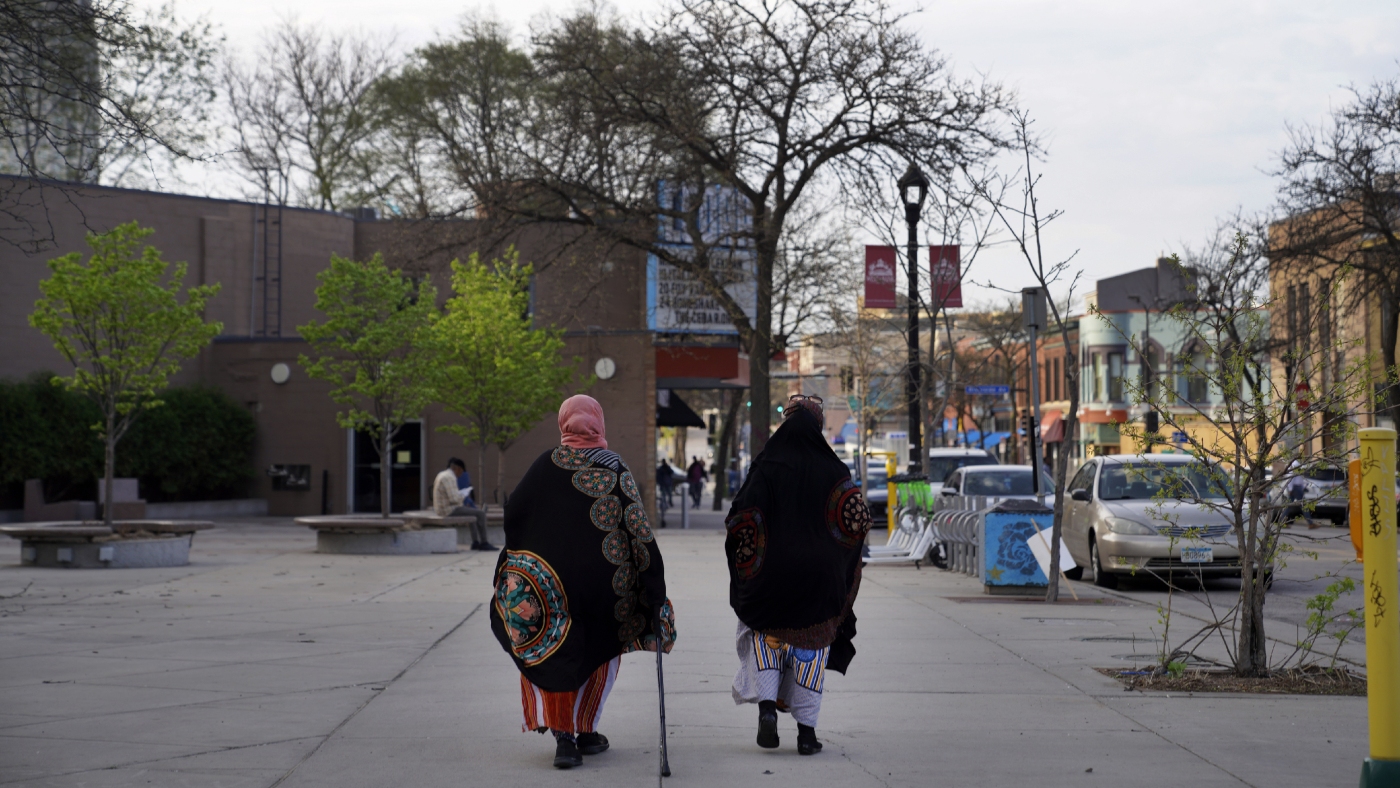

Women walk down a street in the predominantly Somali neighborhood of Cedar-Riverside in Minneapolis in 2022. The Twin Cities are a hub for Somalis in the US.
Jessie Wardarski/AP
hide title
toggle title
Jessie Wardarski/AP
Minnesota has the largest population of Somalis in the United States, a community that recently faced attacks from President Trump.
On Tuesday, Trump called Somali immigrants “trash” and said he wanted to send them “back to where they came from.” He continued Wednesday saying, “they have destroyed our country and all they do is complain, complain, complain.”
The tirade came less than two weeks after Trump threatened to withdraw temporary legal protections for Somali immigrants living in Minnesota.

Trump and other conservatives have also recently seized on criminal investigations and news stories about fraud in Minnesota’s social services system (some of which was allegedly committed by Somalis) to disparage the entire community.
Now, U.S. Immigration and Customs Enforcement plans to target Minnesota and its Somali population in an upcoming immigration enforcement operation, The Associated Press and other outlets reported this week.
Nearly 80,000 people of Somali ancestry currently live in Minnesota, about 78% of whom reside in the Twin Cities, according to the St. Paul-based group Wilder Research.
But it didn’t start with the Twin Cities. Rather, some of the first Somali immigrants to arrive He entered the United States in the late 1990s and arrived in a city called Marshall, about 150 miles west of Minneapolis, according to Minnesota author Ahmed Ismail Yusuf, who wrote the book. Somalis in Minnesota.

Somalia at the time was mired in a civil war that caused hundreds of thousands of people to flee the country located in the Horn of Africa, and some of those who came to the United States found work at a Marshall meatpacking plant. As word spread about job opportunities in Marshall, other Somali refugees came to the region and took jobs in the hospitality industry, as taxi drivers and more, Yusuf said, forming a significant Somali community in and around the Twin Cities.
“Those people who were hired, they brought their families. And when they brought their families with them, their families, of course, brought their children with them,” he said.
Somali refugees who settled in Minneapolis and St. Paul were also attracted by the fact that Minnesota was known for martisorwhich translates to “hospitality” in Somali. Yusuf said the state’s “liberal attitude and social behavior” reflects immigrants’ own values.
For some Somali refugees, the transition to living in Minnesota has not been entirely easy. Some religious Somalis have faced barriers to practicing their Islamic faith, which can involve praying several times a day and wearing a hijab for Muslim women, according to the Minnesota Historical Society.
The society said the Somali population has also struggled to overcome its association with Islamic extremism, after the community became a recruiting target for ISIS more than a decade ago.
Still, Yusuf said the Somali population has continued to grow in Minnesota and has found ways to give back. “Right now, wherever we go, we continue to serve the people, serve the community, serve the state,” he said.
Minnesota Democratic Rep. Ilhan Omar, who fled Somalia as a child and came to the United States as a refugee, became the first Somali American elected to Congress in 2018.
Trump said Wednesday that Omar “should not be allowed to be a congresswoman, and I’m sure people are looking at that. And she should be kicked out of our country.”
Omar said in a Tuesday social media post in response to Trump’s earlier comments: “His obsession with me is creepy. I hope he gets the help he desperately needs.”
She was one of four congresswomen who Trump said in a 2019 tweet should “go back and help fix the totally broken and crime infested places they came from.” At a rally shortly after his tweet about Omar, Trump paused as some members of the crowd chanted, “Send her back.”
Yusuf said the Somali community is now “a little bit under siege” by the Trump administration, but noted he also has the support of Twin Cities leaders, including Minneapolis Mayor Jacob Frey and St. Paul Mayor Melvin Carter.
“We are dealing with this,” Yusuf said, “but we are not dealing with it alone.”
