


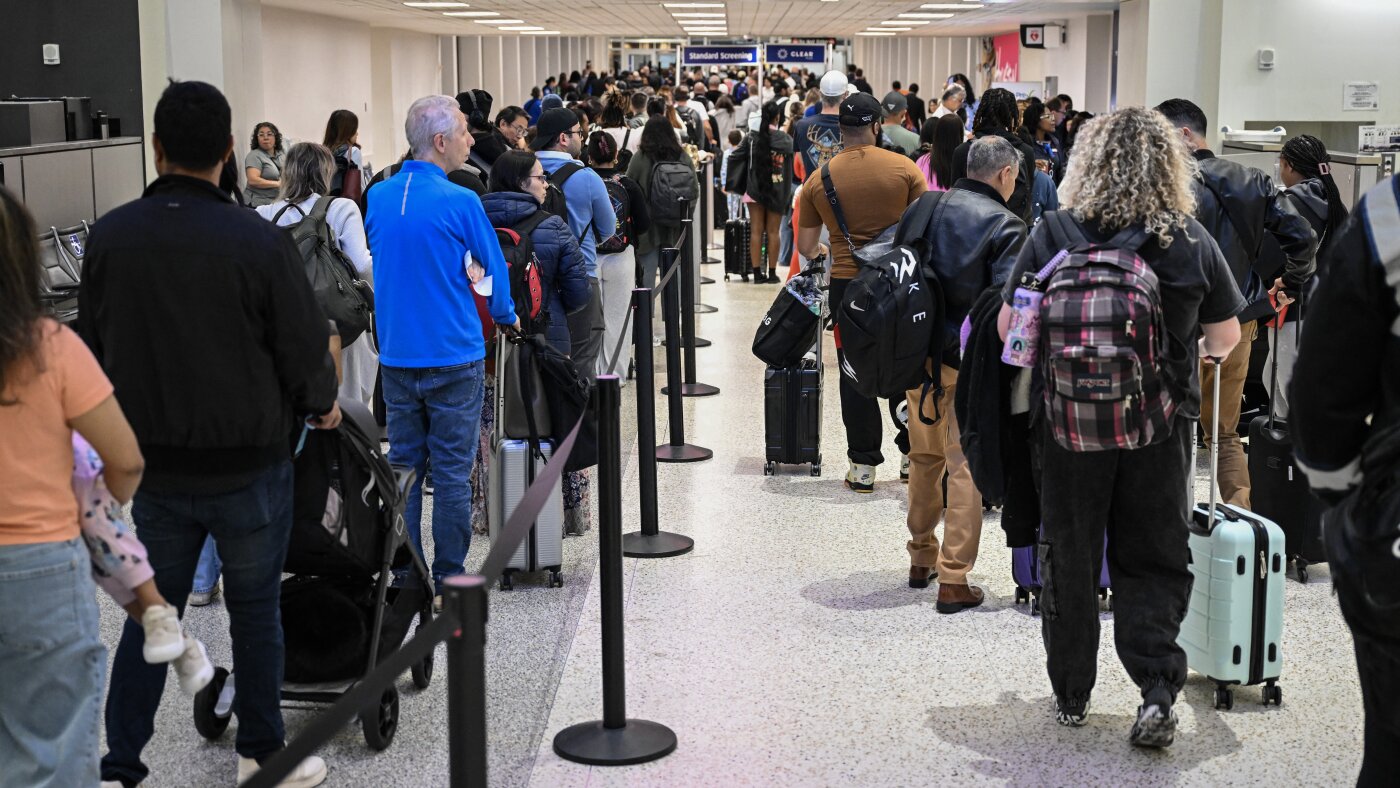

Travelers wait in line at a TSA security checkpoint at George Bush Intercontinental Airport in Houston, Texas, on March 20, 2026.
Ronaldo Schemidt/AFP via Getty Images
hide title
toggle title
Ronaldo Schemidt/AFP via Getty Images
It’s spring break season in the United States and travelers are facing long lines at airports as security screeners work without pay while the Department of Homeland Security is closed.
Congressional Democrats have refused to fund the agency in an attempt to force reforms to federal immigration enforcement practices.
Wait times at major hubs Houston and Atlanta reached two hours on Friday, while Louis Armstrong New Orleans International Airport advised passengers to arrive at least three hours before their scheduled departures. In Philadelphia, airport officials completely closed three security checkpoints this week due to staffing shortages.
On Saturday, President Trump threatened to send Immigration and Customs Enforcement agents into airport security lanes if Democrats don’t “immediately” agree to fund DHS. A bipartisan group of senators has been negotiating with the White House on immigration enforcement and ending the shutdown.
“I will move our brilliant and patriotic ICE agents to airports, where they will provide security like never before seen, including the immediate arrest of all illegal immigrants who have entered our country,” Trump posted on Truth Social. In a follow-up post, he said he told ICE that they will “PREPARE” to deploy to airports on Monday.
Why are wait times so long?
Officials say wait times are unpredictable and can fluctuate dramatically as airports struggle with Transportation Security Administration staffing shortages.

TSA staff are considered essential workers, so around 50,000 have been working without pay due to the shutdown that began on February 14. Last week, they missed their first full paychecks. The Department of Homeland Security says more than 300 TSA agents have resigned. More than half of TSA staff in Houston called in sick and nearly a third in Atlanta and New Orleans last week, DHS said.
The staffing shortage comes as travel has also been affected by severe weather and schools across the country close for spring break.
About 2.8 million people were projected to travel on U.S. airlines each day in March and April, adding a record 171 million passengers, according to industry group Airlines for America.
What do the officials say?
Transportation officials warn that the situation could worsen if the closure is not resolved. A second missed paycheck would put even more pressure on TSA workers, Transportation Secretary Sean Duffy told CNN on Friday.

“If an agreement is not reached, what is happening today will seem like child’s play,” Duffy said. “Is it still safe to go through the airport? Yes, but it takes much longer because we have fewer agents working.” He added that some smaller airports could be forced to close temporarily if more staff come calling.
In the UK, Foreign Office officials are also warning travelers of “travel disruption” caused by “longer queues than usual at some US airports”, and advised passengers to check with their travel provider, airport or airline for guidance.
On Saturday, billionaire Elon Musk weighed in with an offer to personally pay TSA staff.
“I would like to offer to pay the salaries of TSA staff during this financial impasse that is negatively impacting the lives of so many Americans at airports across the country,” Musk posted on X early Saturday morning.
U.S. law generally prohibits government employees from receiving outside compensation for their work.
Even With Disruptions, Travel Demand Remains High
In addition to long security wait times and climate impacts, travel is being affected by the war in Iran, which is driving up global oil prices.

On Friday, United Airlines said it would cut some flights over the next six months after jet fuel prices doubled in recent weeks. The capacity cuts are likely to push airfares even higher, even as ticket prices are already rising, said Clint Henderson, spokesman for the travel website The Points Guy.
Still, he said, none of that seems to deter Americans from flying.
“The appetite for travel is insatiable,” he said. “People seem willing to put up with a lot to travel. And I don’t see any signs of that slowing down.”
How can travelers prepare?
Travel experts say travelers should not only prepare for long wait times, but also uncertainty.
“Every day this happens, it gets worse and worse,” Henderson said.
Here are some tips on how to prepare for upcoming air travel:
1. Find out before you go
Many airport websites list estimated security wait times. That should be the first place you check to get an idea of how long the lines can be, Henderson says. (TSA also estimates wait times on its website and app, but it is not updated regularly due to the closure, he added.)
“Knowledge is power,” Henderson said. “You should know what’s going on at your local airport.”
He noted that there are 20 U.S. airports where security screening is done by private contractors, not the TSA, and that they are not experiencing staffing shortages or long waits. Some are smaller regional airports, but the list also includes some larger hubs, such as San Francisco International Airport and Kansas City International Airport.
“There are very, very large metropolitan areas where it’s not a problem at all,” Henderson said.
2. Budget for extra time
If you’re someone who shows up at the airport when your flight starts boarding, think twice, says travel writer Chris Dong.
“I’m the type of traveler who usually arrives at the last minute,” Dong said, “but I think that advice would not be accurate for the current situation.”
Even if wait times are listed as short, things can change in the blink of an eye. Dong recently flew out of John F. Kennedy Airport in New York and found the TSA PreCheck line closed unexpectedly.
“So everyone who was funneled through the regular line, it was about an additional 20 or 30 minutes,” he said. “I was sweating because it usually came in at the last minute. And those levels of uncertainty are greater now with the shutdown.”
3. Consider biometric testing
Henderson typically recommends signing up for TSA PreCheck or the Global Entry program to get through airport security more quickly and opt for biometric screening. This must be done in advance and travelers must also choose biometric screening in their airline apps.
“Make sure that’s an option and you’ve chosen it, because that will save you a lot of upheaval,” he said.
For those who have not registered in advance, there is a last-minute alternative: the private CLEAR program, which allows you to register at the airport. Henderson notes that it’s expensive (annual membership costs $209), but that some credit card companies will refund that fee.
“For me, skipping a three-hour line is probably worth the membership fee, especially if you know your credit card will pay you back,” he said.
That said, expedited check lanes are not always faster than regular checks, both Henderson and Dong cautioned. Always check what all lanes look like when you arrive at the airport.
4.Make a plan B
If you miss a connection or your flight is cancelled, be proactive in rebooking. “Have all the tools available in the toolbox in case something goes wrong,” advises Henderson.
That includes installing your airline’s app on your smartphone and writing down their customer service number, so you don’t have to scramble to find it.
“And then, you know, obviously have a plan B,” Henderson said. “Know which other airlines fly the route you want to take in case you missed your Delta flight and American is offering a flight you can take later in the day.”
He says that while airlines generally don’t like to rebook passengers on competing flights, it’s worth asking. He also recommends having information on hand to give to customer service agents, including flight number, airline, and departure time.
And if an airline cancels your U.S. flight, you’re entitled to a refund, according to the Department of Transportation.