

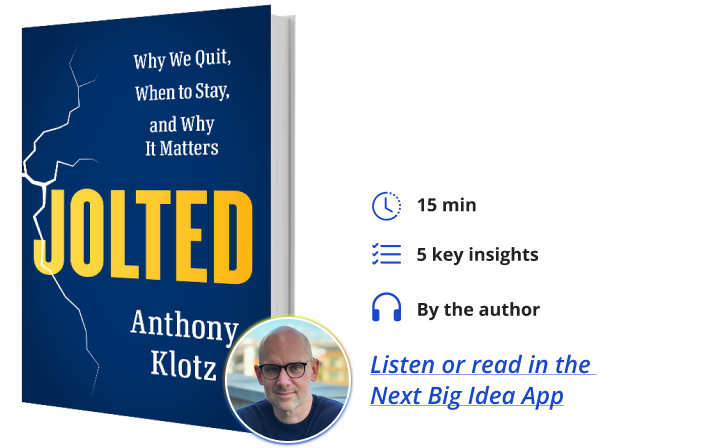
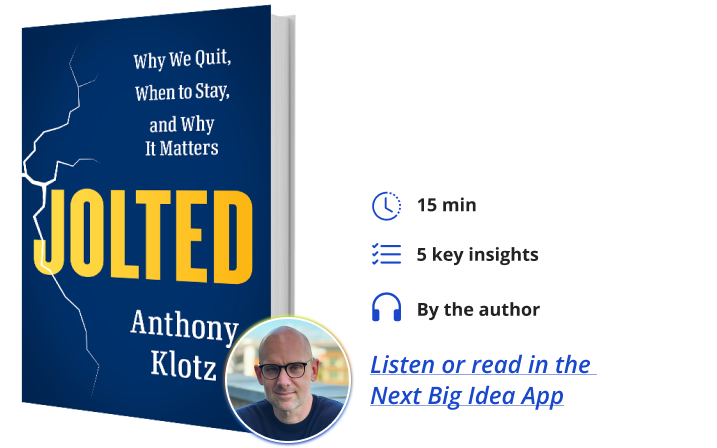
Below, Anthony Klotz shares five key insights from his new book,Shaken: Why we quit, when to stay, and why it matters.
Klotz is a professor of organizational behavior at the UCL School of Management in London. He is best known for predicting the pandemic-related Great Resignation. He has written for Harvard Business Review and The Wall Street Journaland his research is regularly published in leading academic management journals.
What’s the big idea?
Even when quitting smoking feels like a slow process that dances in your mind for months (or even years), the truth is that finally quitting is caused by a sudden spark. Unexpected “shocks” prompt us to rethink our work, often leading to impulsive exits, but we can respond more deliberately to make smarter career decisions.
Listen to the audio version of this Book Bite, read by Klotz himself, on the Next Big Idea app or purchase the book.
1. We are all one step away from leaving our jobs.
If you had enough money to live as comfortably as you would like for the rest of your life, would you continue working or stop working?
Every two years since 1972, the General Social Survey has asked this same question of a representative sample of Americans. For most of that time, results have consistently indicated that about 7 in 10 people would continue working even if they didn’t need the paycheck. Global surveys indicate similar findings. But then the pandemic hit, and the number of people who reported they would continue working if they won the lottery plummeted to an all-time low. This drop corresponded with a historic increase in people leaving their jobs: the Great Resignation.
When I teach and speak, I ask the lottery question and always find similar results. However, a public professional once asked me to rephrase the question so that instead of asking How many people would still work?asked How many people would leave their jobs? if they won the lottery. I’ve put it this rephrased way many times since, and I consistently find that only about 10% of people would continue working at their current job if they became rich.
“But then the pandemic hit and the number of people who reported they would continue working if they won the lottery plummeted to an all-time low.”
What do the changes in these responses to the lottery questions (before and after the pandemic, and between working in general and working at your current job) tell us about our relationship with work? We are all just one event away from leaving our jobs. These events, called jerksThey occur much more frequently than lottery wins or pandemics.
2. “Shakes” are the missing piece of the quit smoking puzzle.
In 2005, comedian Dave Chappelle abruptly left his television show at the height of his success. What made you suddenly walk away?
Organizational psychologists have studied the causes of attrition for over a century, and for most of that time, the research could be boiled down to two main reasons for attrition:
- The negative parts of your job accumulate over time and push you to quit.
- When positive opportunities for other jobs or careers are attractive enough, they draw you away from your current job and toward the exit door.
Push and pull. These two forces are intuitive and powerful, and explain why people quit smoking in many cases. The only problem is that they only explain about half of the abandonments that occur in the world of work. What about the other half, like Chappelle’s sudden departure from success?
In the early 1990s, organizational researchers Tom Lee and Terry Mitchell found the missing piece of the puzzle. They proposed, and later provided evidence, that quitting often results from a single event that shakes employees and makes them rethink their relationship with work. Explaining why he left, Chappelle described one such jolt, in which a single colleague’s bad behavior during a specific episode sparked reflection and then a strong urge to walk away from the show.
If you think back on your own life, you probably remember some of the jokes you’ve experienced: events, big and small, that stop you in your tracks and often lead you to make major changes in your career.
3. You will encounter six types of shakeups in your life.
Over the past three decades, researchers, including myself, have cataloged the different types of shocks that drive employees to quit:
- Instant ShakesThey come from negative events that happen to us at work. They can range from major flaws that make us question whether we are fit for our job, to minor slights like a rude comment from our boss.
- Lateral jerksThey reach us collaterally, the mood of the events that happen to our co-workers. These also include when our colleagues quit their jobs, and it affects us through a process calledbilling contagion.
- External shocksreside outside of work, when negative events in our personal lives reveal that we need to rethink our relationship with work.
- Specialized jerkslike those who strike during what is, somewhat counterintuitively, the most common time to quit in all organizations: the first year on the job.
- Distant shakesIt doesn’t affect us directly, but it can still shake us. Science increasingly reveals how and why we are influenced by events in distant places.
- Positive shakesThey come from the positive side of life, arising from the big and mundane positive events in our lives.
The shakes are everywhere! Because shocks are so frequent, it can be difficult to determine when we should take action in response to them, rather than just moving on. But finding out is essential, given what is at stake.
4. The honeymoon hangover effect is real, but avoidable.
In the years after the Great Resignation, dozens of news stories reported that some workers who quit during that period eventually regretted their decision. Some even went so far as to call it the Great Repentance. However, for those of us who study turnover, we would expect an increase in regret after an increase in resignations, due to what is known as honeymoon hangover effect.
One of the most common mistakes people make in response to jitters is quitting too soon. Although quitting quickly is sometimes justified, it is often a one-way ticket to regret. Discovered and coined by management expert Wendy Boswell, the honeymoon hangover effect describes the reality that many job and career changes lead to an immediate increase in happiness and well-being, followed by a crisis that leaves many workers less happy in their new position than the one they just left.
This collapse comes from two places. First, it comes from a shock in which you realize that one or more expectations you had about your new job are not going to be met. Second, it comes from realizing that you could have taken steps to fix the problem at your previous job before you quit.
“One of the most common mistakes people make in response to shaking is quitting too soon.”
While it’s normal to have mixed feelings after leaving a job, regret doesn’t have to be one of them. By developing a strategy for responding to shocks that goes beyond the binary options of continuing or leaving, we can maximize our chances of fixing our relationship with work without quitting or doing so in a way that avoids hangovers in our next chapter.
5. You can learn to date better.
In 2012, Greg Smith quit his job at Goldman Sachs and published an op-ed in The New York Times which places the bank in an unfavorable situation. Although bridge-burning resignations remain rare, thanks to social media, examples of them are more common than ever.
However, rather than actively damaging their relationship with the soon-to-be former employer, most employees try to resign in a way that preserves or strengthens it. And yet, people often say no in ways that unnecessarily damage their connection to the company or don’t set them up for success in their next role. Quitting smoking is complicated and doesn’t come with a guide, and you often can’t ask for help from the most useful sources of information: your current coworkers and your boss. Still, we can quit smoking better.
The pre-resignation period is critical because it is when we decide what reason we will give for our departure, who we will trust (if anyone) before sending our notice, and how we will say goodbye.
“The period leading up to resignation is critical.”
Then comes the actual resignation. In my research, I discovered that there are seven different ways people quit, and each has different consequences for their final days on the job and their future relationship with their former employer.
Finally, there’s that awkward moment after you’ve announced your departure but before you leave. When navigated well, the notice period can provide a satisfying closure to one chapter of your life and a smooth transition to the next.
Enjoy our complete library of Book Bites (read by authors!) in the Next Big Idea app.
This article originally appeared onNext big ideas clubmagazine and is reprinted with permission.
