

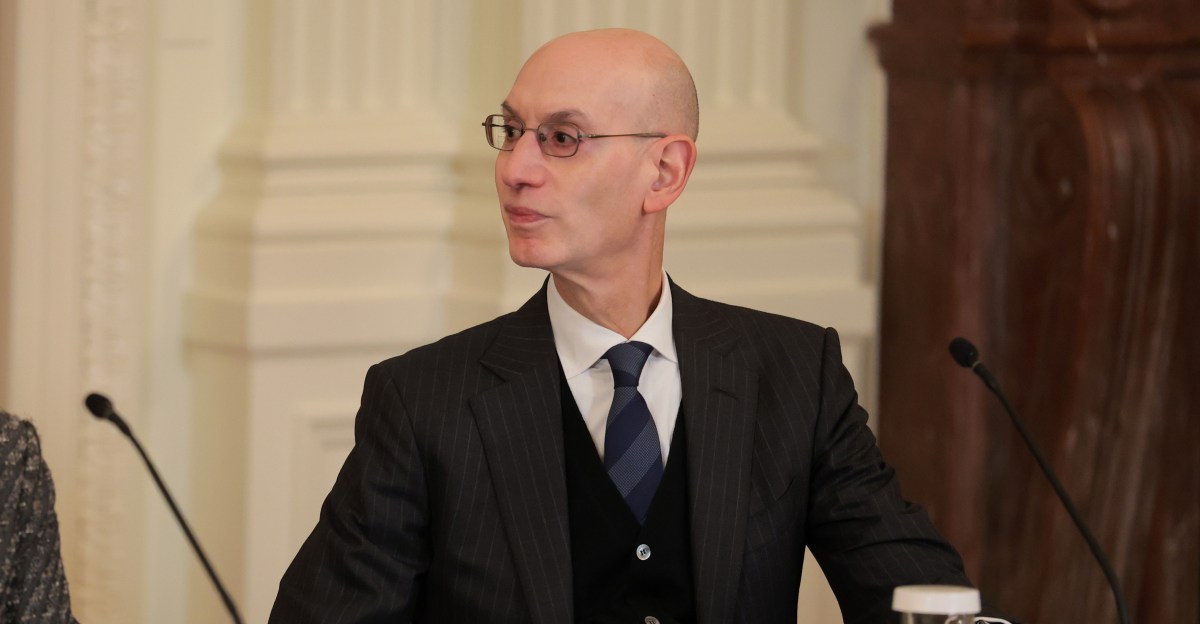
Adam Silver heard the outcry about failure ahead of a loaded 2026 NBA Draft and was determined to find a solution. The league has now settled on its preferred lottery reform system, essentially reducing the distribution of the best young talent entering the league to complete randomness.
ESPN insider Shams Charania revealed the NBA’s new “3-2-1” lottery system Tuesday night. Here’s what you need to know:
- The three worst teams in the league are in the “relegation zone,” which means they lose ping-pong balls.
- Teams that finish 4th through 10th in the reverse standings will get three lottery balls in the drawing.
- Teams in the “relegation zone” get two lottery balls and cannot drop further than the 12th pick.
- “The No. 9 and 10 seeds from each conference receive two lottery balls each, and the losers of games 7-8 receive one lottery ball each.”
- The lottery has been expanded from 14 to 16 teams.
- Under the current system, lottery balls are only drawn for the top 4 picks. Now, the first 16 spots in the draft will be up for grabs in the draft.
- Teams cannot get the first pick in consecutive years and cannot be in the top five three times in a row.
Do you have all that? Probably not, because it’s quite complicated. When Adam Silver was weighing multiple options for reforming the NBA Draft lottery last month, I wrote “by rushing to find a medicine to cure stagnation, the NBA risks creating bigger problems because of the side effects.” While this system will likely slow down tanking to some degree, it opens up a ton of new problems for the league.
It’s quite strange that Silver accelerated this system so quickly when it is scheduled to go into effect for the 2027 NBA Draft. Teams were already making long-term roster decisions based on the incentives of the old rules. The Chicago Bulls traded Ayo Dosunmu and Coby White at the deadline after years of teetering on mediocrity to boost their chances of finding a star. this system rewards mediocrity. It would have been nice if Chicago actually knew the rules before closing their February deals. The Memphis Grizzlies traded Jaren Jackson Jr. and Desmond Bane because they felt they couldn’t get out of the middle of the Western Conference standings. Would Memphis have made the same decisions if it had known the lottery format would change like this?
It’s no surprise that the league was given the option to opt out of this plan after the 2029 NBA Draft, according to Charania’s report. This lottery format seems like an extremely slippery slope for several reasons. Let’s get into it.
New lottery system kills hopes of die-hard fans of bad teams
Teams had the ability to go from worst to first under the current lottery system even though the league’s worst team has literally never won the lottery since the last round of reform went into effect in 2019. The Detroit Pistons, San Antonio Spurs, Oklahoma City Thunder and Minnesota Timberwolves all made the jump from worst to first in the 2020s.
Those are all small market teams that used the draft to get their franchise player. They still had to get lucky to get the first pick. It will just take a lot more luck for bad teams to become good under this system.
The risk of this system is that it creates a permanent underclass in the NBA. Now the worst team in the league may fall to 12th. Considering that good players change hands in free agency these days (more on that later), it seems like bad teams could be stuck in a cycle of being bad for a long, long time.
If teams can’t sell wins, they must sell hope. What hope would fans of bad teams have now knowing that they could be left out of the top 10 of the draft? The risk here is that die-hard fans of bad teams will simply decide to give up because there is no way forward.
It seems that lottery reform should be accompanied by changes in free agency
How are bad teams supposed to get good players if they can’t do it during the draft? Free agency and trades are the only other options, but the prospect of bad teams overpaying free agents to land them only offers more downsides, especially in this more punitive CBA.
It seems like the league needs more good young players to hit free agency if it doesn’t want teams to tank in the draft. One idea I saw elsewhere that I liked was eliminating restricted free agency. Under the current system, the Pistons still have the ability to match any contract offer to Jalen Duren even after failing to reach an extension with him. What if Duren was simply an unrestricted free agent this year and could be signed by any team?
Something like this would open more avenues for acquiring talent outside of the draft. For now, it seems like the bad teams that are unlucky in the lottery are simply screwed.
The NBA is done with free agency. Will these changes also kill exchanges?
Silver heard the outcry over Kevin Durant signing with the Golden State Warriors and essentially made rule changes that kept superstars away from free agency. The last true superstar to change teams in free agency was Kawhi Leonard who signed with the Los Angeles Clippers in 2019. Since then, the biggest player to change teams in free agency is… washed Paul George in 2024?
The NBA gets a lot of attention from off-season player movement. I wonder if these changes will make teams more reluctant to trade their future first-round picks, thus decreasing the trade market as well.
First-round picks are the bargaining chip. A team around .500 was more incentivized to trade a future first because it had a lower chance of becoming a premium pick. Now that has been turned upside down.
This is all pretty speculative for now, but it’s something we should monitor. This new lottery system will have unintended consequences and would be a net loss for the NBA if it resulted in fewer trades.
Tanking will still occur under these lottery rules, just in different ways.
This lottery system should curb gridlock, but it will not eliminate it completely. If the goal of these changes is to preserve the sanctioning of the March and April games, I’m not sure that’s going to happen.
Let’s say a team enters the All-Star break in 10th place in its conference. They may not want to risk losing a ping pong ball coming into the 7/8 play-in game, so they will continue to rest players as long as they have a big enough cushion to not finish in the bottom 3. The sweet spot for this reform is the 4-10 range. Given how often injuries influence team performance (and given how many major injuries there are in the modern game), it seems likely that a team could still rest players/try to lose on purpose from an organizational perspective and still enter the lottery with good luck.
Tanking was never the NBA’s biggest problem anyway.
Adam Silver is a reactionary. Read online reviews and act quickly. My complaint about rushing this tank overhaul is that the fans of the failing teams aren’t the ones complaining. It usually comes from football fans after the Super Bowl, who will simply find another way to criticize the NBA even if the tank issue was resolved.
The NBA’s biggest problem is that the regular season lacks anything resembling what’s at stake.. Silver believes these lottery reforms will solve that problem, but I have many doubts. If the NBA wants to give more play to the regular season, it needs to reduce the number of games. Play each team twice and finish the season. Once the NBA adds its two expansion teams in Las Vegas and Seattle, a 62-game schedule would be created. It gives players more rest between games and cancels many of the late-season games where nonsense occurs.
The goal of the draft is to give the worst teams the best young players. The NBA apparently doesn’t see it that way and instead leaves everything to chance.
This lottery simulator shows how much randomness there is in the new system. Play with it yourself:
In my first spin, the Miami Heat got the No. 1 pick and the Washington Wizards fell to No. 12. Is that the kind of system the NBA really wants?
The biggest winner of these lottery changes feels like… the Oklahoma City Thunder. See all the future first-round picks OKC owns here. Now their future picks coming from the Nuggets and their trade rights to the Clippers could be even more valuable, as those teams probably wouldn’t have been near the bottom of the standings, but could be in the middle ground that is now more fruitful.
In 2017, the great Tom Ziller wrote a column on this site titled “Killing the NBA Draft.” Sign up for Tom’s newsletter here for more great NBA coverage.
Given the randomness in this new system, I’m much more open to simply eliminating the draft entirely starting in 2030. Give each team a rookie exception that they can offer to the best players. Let the teams with cap space offer them more money beyond that. It would make sense if a bad team had more cap space and could hypothetically offer the next Cooper Flagg a max contract out of college. If Flagg prefers to sign with his childhood favorite Boston Celtics, so be it.
The NBA is opening a new can of worms with this lottery system, and the people it hurts the most are the loyal fans of desperate franchises. The NBA really doesn’t want a world where those people leave the league entirely. I feel like it might happen after these changes.
