

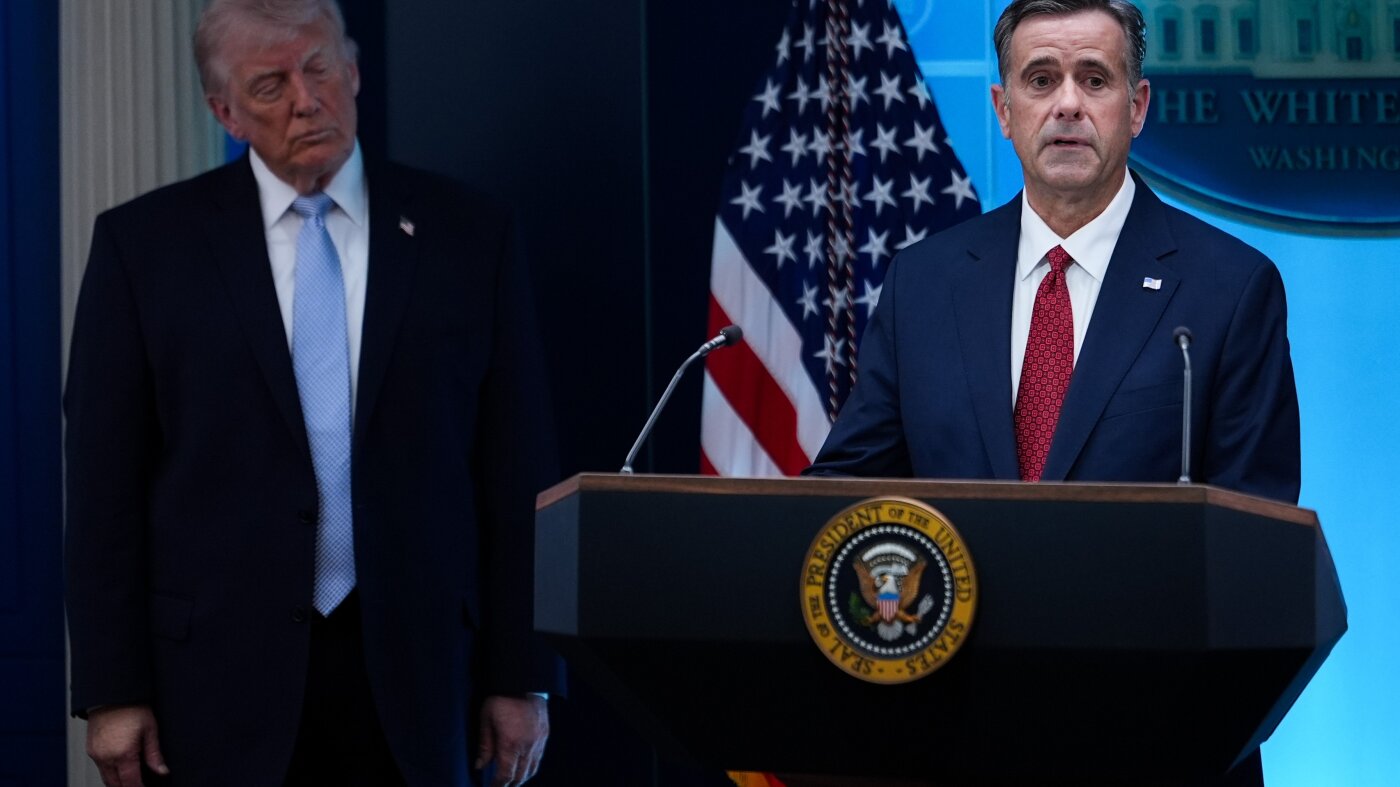

FILE – CIA Director John Ratcliffe, accompanied by President Donald Trump, speaks to reporters in the James Brady Briefing Room at the White House in Washington, April 6, 2026.
Julia Demaree Nikhinson/AP
hide title
toggle title
Julia Demaree Nikhinson/AP
HAVANA – CIA Director John Ratcliffe met with Cuban officials, including Raúl Castro’s grandson, during a high-level visit to the island on Thursday, Cuban and US officials said.
Ratcliffe met with Raúl Guillermo Rodríguez Castro, the Minister of the Interior, Lázaro Álvarez Casas, and the head of the Cuban intelligence services, and discussed issues of intelligence cooperation, economic stability and security. A CIA official confirmed the meetings to the AP.
Ratcliffe was there “to personally convey President Donald Trump’s message that the United States is prepared to seriously engage on economic and security issues, but only if Cuba makes fundamental changes,” the CIA official said.
An official statement from the Cuban government noted that Thursday’s meeting “took place… in a context of complex bilateral relations.”
While the United States stressed that Cuba can no longer be a “safe haven for adversaries in the Western Hemisphere,” the Cuban delegation insisted that the island poses no threat to American security. Cuban officials also took issue with the nation’s continued inclusion on the U.S. list of state sponsors of terrorism.
Rodríguez Castro previously met secretly with US Secretary of State Marco Rubio on the sidelines of a Caribbean Community summit in St. Kitts in February. While he never held a government position, he served as his grandfather’s bodyguard and later as head of the Cuban equivalent of the Secret Service.
American and Cuban officials also met earlier this year in Cuba. The ongoing meetings between U.S. and Cuban officials mark the first U.S. government flights to land in Cuba outside of the U.S. Naval Base at Guantanamo Bay since 2016.
Thursday’s meeting comes weeks after the Cuban government confirmed it had recently met with U.S. officials on the island as tensions between the two sides remain high over the U.S. energy blockade of the Caribbean country and as Cuba’s power grid collapsed and power was cut to its eastern provinces. The US fuel blockade of the island has caused economic problems, with reduced work hours and food spoilage when refrigerators stop working.
Earlier this week, the US State Department reiterated that the United States will provide Cuba with $100 million in humanitarian assistance and support for satellite internet “if the Cuban regime allows it.”
In late January, Trump threatened to impose tariffs on any country that sells or supplies oil to Cuba. Although Trump has also threatened to intervene in the country, and Cuban President Miguel Díaz-Canel recently said his country was prepared to fight if that happened, sources told the AP earlier this month that military action is not imminent.
