

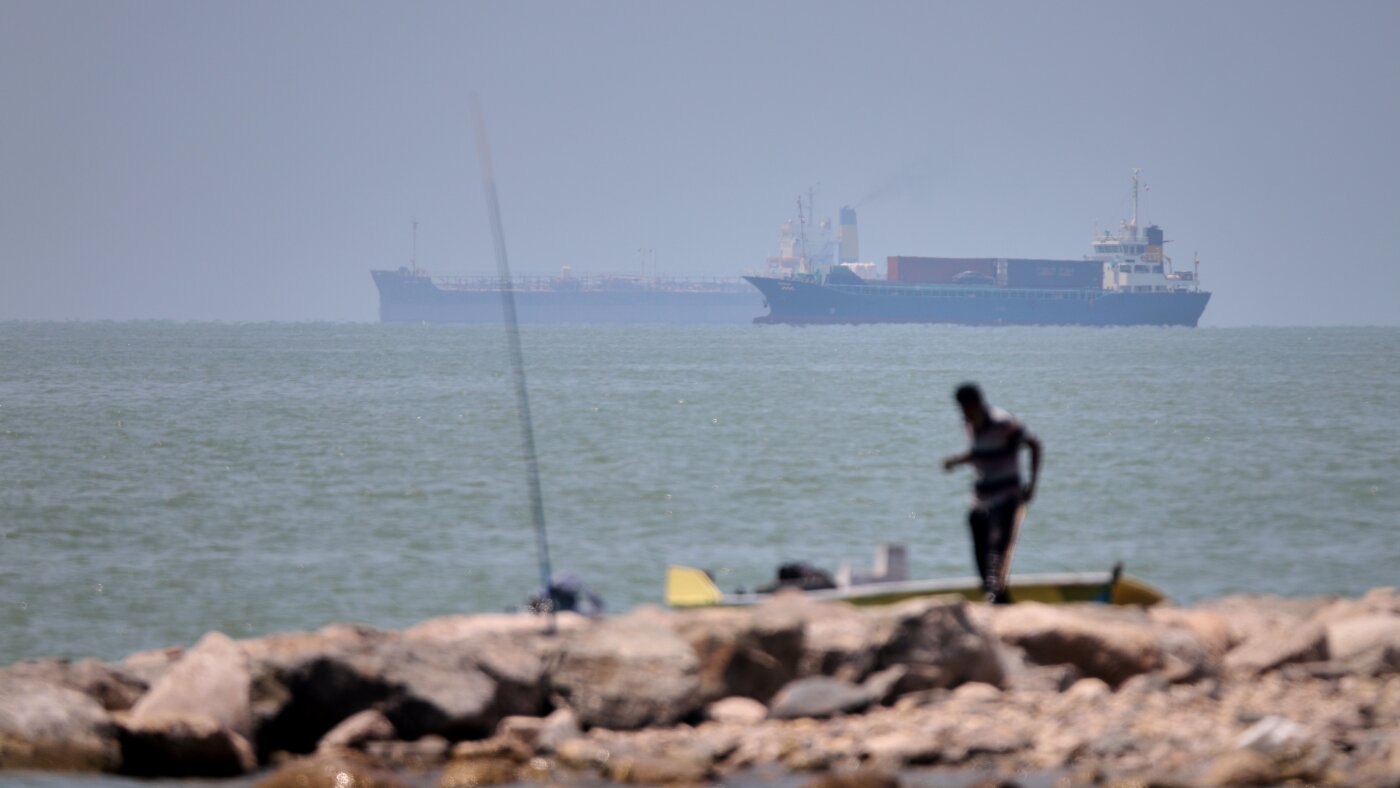

A man stands next to a fishing rod along the coast as cargo ships and commercial vessels are seen in the Strait of Hormuz off Bandar Abbas, Iran, Wednesday, June 17, 2026.
Amirhosein Khorgooi/AP Photo/Amirhosein Khorgooi/ISNA
hide title
toggle title
Amirhosein Khorgooi/AP Photo/Amirhosein Khorgooi/ISNA
DUBAI, United Arab Emirates – A United Nations agency halted the evacuation of ships through the Strait of Hormuz on Thursday after the British military said a ship was hit by a shell off the coast of Oman following the passage of several oil tankers using a U.N.-backed route.
The head of the International Maritime Organization said the plan to move stranded ships out of the Persian Gulf through the strait will be put on hold until the agency can confirm safety guarantees for ships on the evacuation list and in the region.
The report of an attack came hours after Iran threatened ships to stop using the route through the strait without Tehran’s permission. The attacked ship was not part of the evacuation efforts, said Arsenio Domínguez, secretary general of the UN agency.
A U.S. official told The Associated Press that the ship was hit by an Iranian drone.
The official, who spoke on condition of anonymity to discuss a sensitive situation, said the merchant ship Ever Lovely was attacked by a drone piloted by Iran’s paramilitary Revolutionary Guard.
Following reports of the attack, Iran’s Persian Gulf Strait Authority (a new government agency established to control shipping in the strait) wrote in X that transit outside its own designated routes “will not be covered by the guarantee of safe passage.”

The UK’s Maritime Trade Operations center said the ship was damaged but reported no injuries or environmental effects from the attack off the coast of Oman.
An alternative passage would ease pressure on the economy
Opening an alternative passage through the vital waterway would ease pressure on the global economy and eliminate Iran’s main source of leverage in ongoing peace talks with the United States. U.S. Secretary of State Marco Rubio, on a visit to the Gulf to reassure U.S. allies, said Washington was committed to the new route and ensuring ships can transit the strait.
“If that stops, then we’re going to have a problem,” Rubio said Thursday before the impact of the attack on the ship was known.
Traffic through the strait has increased in recent days, but was still well below pre-war levels. Oil briefly fell below its last pre-war price of just under $73 a barrel on Thursday, a sign that the market believes the situation is improving.
The United States and Iran are still debating the terms of an interim peace deal, including issues such as passing ships through the narrow mouth of the Persian Gulf and addressing the future of Iran’s stockpile of highly enriched uranium.
Under the memorandum of understanding signed last week, the United States and Iran have 60 days to iron out the details. As talks take place behind closed doors, US President Donald Trump and Iranian leaders appear to be negotiating in public, exchanging threats and demanding concessions that the other side denies.
Meanwhile, an upsurge in fighting in Lebanon between Israel and Iran-backed Hezbollah militants threatened the broader stunt. Lebanon says five people have been killed by Israeli strikes in the past two days. Iran says the tentative deal to end the war would require Israel to withdraw from Lebanon, a condition Israel has rejected.
More ships pass through the strait, but far fewer than before the war.
The tankers, led by the Stoic Warrior, sailed along the United Arab Emirates and then Oman early Thursday, passing through Oman’s Musandam Peninsula fairly close to the coast. The route was laid out by Oman and the International Maritime Organization.

Bahrain’s Foreign Minister Abdullatif bin Rashid Al Zayani speaks with U.S. Secretary of State Marco Rubio, right, upon arrival at Bahrain International Airport during his visit to the Middle East to discuss the interim U.S.-Iran deal with Arab Gulf allies, in Muharraq, near Manama, Bahrain, Wednesday, June 24, 2026.
Eric Lee/Eric Lee/Pool Reuters/AP
hide title
toggle title
Eric Lee/Eric Lee/Pool Reuters/AP
North of the route is a corridor in the center of the strait where ships moved freely before the war, carrying about a fifth of all the world’s oil and natural gas.
Iran said it understood that step after the United States and Israel attacked it on February 28. At least one mine has been sighted there.
Although some ships had been leaving the strait, with US military support, the UN agency’s effort was the last to free the trapped ships. Shipping company Maersk said its container ship, the Maersk Baltimore, and another chartered ship set sail on Thursday.
Last week, 125 vessels crossed the strait, up from 33 the previous week, according to marine data and analysis firm Lloyd’s List Intelligence.
According to S&P Global, there were 78 transits on Wednesday, the most since the war began, but still below the prewar daily average of 130 or more.
Iran says new sea route ‘unacceptable’
The naval arm of the Revolutionary Guard warned Thursday against using the new route.
In a statement carried by Iran’s state news agency IRNA, naval officials said the route was established without warning or coordination with Iran, calling it “unacceptable and completely dangerous.”
“The only authorized route to pass through the Strait of Hormuz is the one declared by the Islamic Republic of Iran,” the Iranian force stated. “Ship traffic outside these routes is extremely dangerous and is prohibited.”
“The violators will be punished,” he added, without giving further details.
On Wednesday, the Guard radioed a tanker truck and was warned by a soldier: “You’re within range of my missiles and I might shoot you,” according to the private security company Ambrey.
Rubio says that the US will guarantee that there are no tolls on ships
Rubio met with foreign ministers from the six-nation Gulf Cooperation Council to assure them that their interests would be protected in any deal with Iran.
Those countries, including major energy producers that rely on the Strait for their exports, were attacked by Iran after the war began.
“There is nothing in this agreement that in any way undermines the security, stability or prosperity of any of our partners in the Gulf region,” Rubio said at the meeting in Bahrain.
Bahrain’s Foreign Minister Abdullatif bin Rashid al-Zayani said the deal brought a glimmer of hope, but stressed that it was “critically important for Iran to fulfill its obligations.”
Lebanon remains a flashpoint
The lull in fire between Israeli forces and Hezbollah that began on Sunday began to show cracks after Israel said it was targeting Hezbollah militants.
Lebanon’s Health Ministry said Thursday that three people were killed by an Israeli attack on a car in southern Lebanon.
Hezbollah has called the recent attacks a violation of the ceasefire, but has not retaliated. The Israeli military said Thursday it fired on two separate groups it suspected were members of Hezbollah. The attacks came while Lebanese and Israeli officials were in Washington discussing a proposed gradual withdrawal of Israeli troops from southern Lebanon.
Israel’s military also said Thursday that a reservist soldier was killed in southern Lebanon.
