


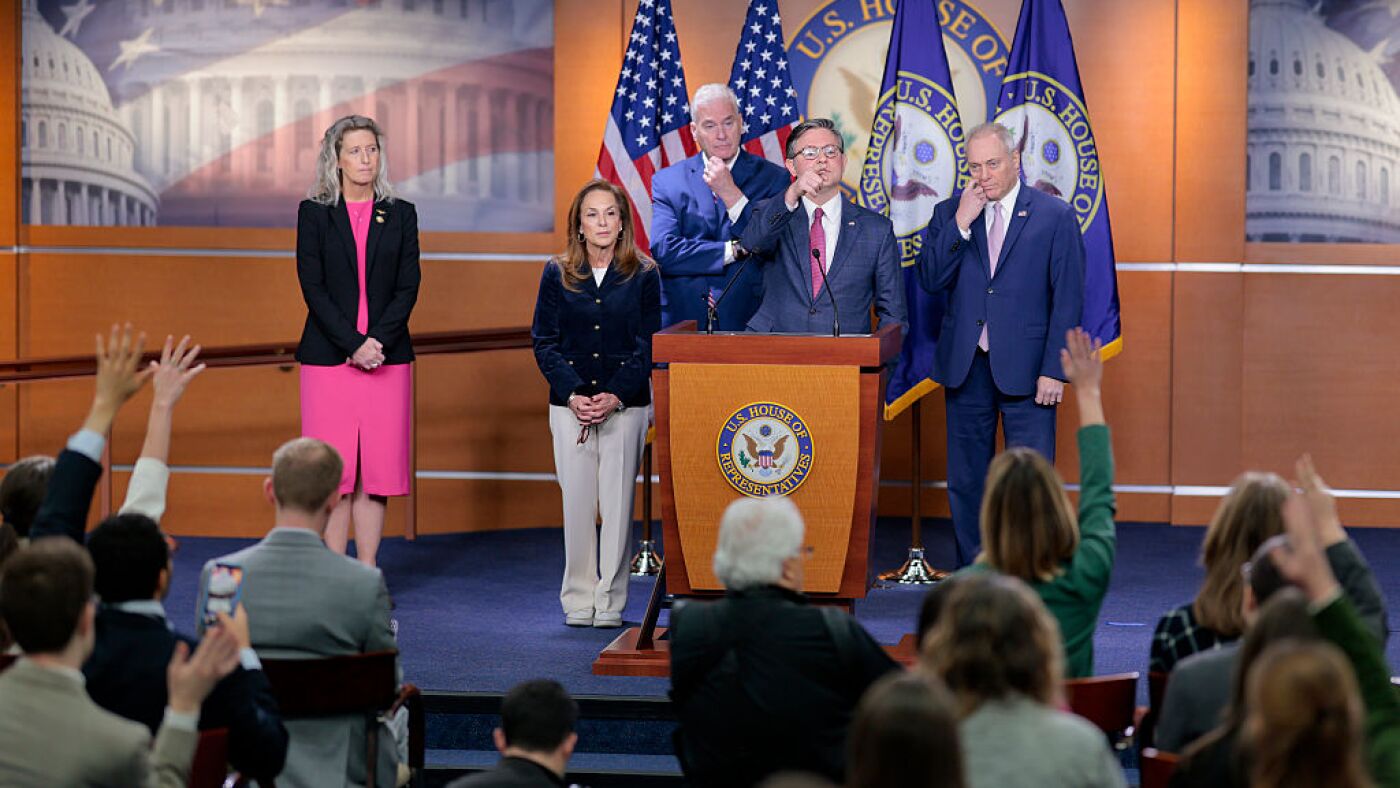

House Speaker Mike Johnson, R-La., and other Republican leaders discussed health care plans with a vote on an impending extension of ACA subsidies.
Heather Diehl/Getty Images
hide title
toggle title
Heather Diehl/Getty Images
We’ve been here before: Democrats and Republicans in Congress arguing over the future of the Affordable Care Act.
But this time there is an extra complication. Although we’re halfway through open enrollment, politicians are still debating whether to extend subsidies that have given consumers extra help paying their health insurance premiums in recent years.
The circumstances have sparked deep consumer concerns about higher costs and fears of political fallout among some Republican politicians.
According to a KFF survey released in December, about half of current registrants who are registered to vote said that if their overall health care expenses (co-pays, deductibles and premiums) increased by $1,000 next year, it would have a “significant impact” on whether they would vote in next year’s midterm elections or on which party candidate they would support.

For those caught in the middle — including consumers and leaders of the 20 states, along with the District of Columbia, that run their own ACA marketplaces — the lack of action on Capitol Hill has created uncertainty about what to do.
“Before I sign up, I’ll wait and see what happens,” said survey participant Daniela Pérez, a 34-year-old education consultant in Chicago, who says her current plan will increase to $1,200 a month from about $180 this year without an extension of the tax credits. “I don’t have much hope. It seems like everything is at a standstill.”
In Washington, as part of the agreement to end the recent government shutdown, a vote was held in the Senate on December 11 on a proposal to extend the subsidies. Another option, proposed by Republicans and including funding health savings accounts, or HSAs, was also considered. Neither reached the 60-vote mark needed for approval.
On the House side, Speaker Mike Johnson plans to bring to the floor this week a limited legislative package designed to “address the real drivers of health care costs.” It would include greater access to association health plans and allocations for cost-sharing reduction payments to stabilize the individual market and reduce premiums. It would also increase transparency requirements for pharmacy benefit managers.
Like the bill introduced by Republicans in the Senate, it would not expand the ACA’s enhanced subsidies. Lawmakers will likely vote on such an extension at some point, but it’s unclear when.
Overall, Democrats want to extend the life of the most generous subsidies, created in response to the COVID pandemic. They are scheduled to expire at the end of the year. Republicans are divided, with many balking at the cost of a simple extension as well as the political implications that could come with a vote to strengthen the ACA, which many have long considered public enemy number one.
And a few back several proposals that would expand tax subsidies, fearing political fallout in next year’s midterm elections.
The result is that lawmakers on both sides of the aisle and in both chambers of Congress are espousing different policy positions.
The White House, although it supports HSAs in principle, has not made clear its choice between the different plans on Capitol Hill.
Meanwhile, the clock is ticking for buyers. People had to choose their ACA plan by Monday for coverage to begin on January 1. Open enrollment continues in most states through January 15 for coverage beginning February 1.
Markets should also have contingency plans in case Congress intervenes. These adjustments could take days or weeks.
“We have a plan in place” to update the website, including notifying consumers of any changes, said Audrey Morse Gasteier, executive director of Massachusetts Health Connector, an ACA insurance marketplace based in the state.
Still, there aren’t many business days left on the Congressional calendar for 2025, and “in many ways, it feels like they’re further apart than they were a few months ago,” said Jessica Altman, executive director of Covered California, that state’s ACA marketplace.
waiting for numbers
Both Altman and Gasteier said it’s still too early to say how final enrollment numbers will come out, but there are already indications of how enrollment will compare to last year’s record of about 24 million.
On December 5, the Centers for Medicare and Medicaid Services released figures from about the first month of open enrollment, showing 949,450 new enrollments (people who did not have ACA coverage this year) in the federal and state markets. That’s down slightly from about the same period last year, when there were 987,869 new enrollees in early December.
However, returning customers who have already selected a plan for next year have slightly increased. According to CMS, the number is about 4.8 million, compared to about 4.4 million at this time last year.
That initial finding — lower new enrollments but quicker action by some already covered — may reflect that “the people who return early in the enrollment period are those who need coverage because they have a chronic condition or need something done,” said Sabrina Corlette, co-director of Georgetown University’s Center on Health Insurance Reform. “That’s why they are more motivated in the first half.”
And it takes time to determine the final number of enrollments in the federal market. “It comes to an end when people have to pay the first premium,” Corlette said. “With the federal market, we won’t know for some time.”
Some states have also released information for the first few weeks, with the caveat that many people may wait until mid-December or later to make coverage decisions. Affordability has become a pressure point.
In Pennsylvania, for example, in the first six weeks of open enrollment there was a 16% decrease in the number of people signing up for the first time compared to last year, according to data released by Pennie, the state’s ACA insurance marketplace. For every one of those new sign-ups, 1.5 existing customers canceled, Pennie reported.
There were some indicators that income is a factor: Most of those who canceled earned between 150% and 200% of the federal poverty level, or between $23,475 and $31,300 for a single adult.
Most states automatically re-enroll existing customers in the same or similar coverage for the following year. Letters and other notifications are sent to consumers, who can then allow coverage to continue or go online during the open enrollment period to change or cancel their plan.
California reported a 33% drop in new enrollments through December 6. And Altman said he’s seeing some other changes, too.
He said more people are opting for “bronze” level plans, which have lower premium payments than “silver” or “gold” plans, but also higher deductibles — the amount people have to pay before most insurance coverage takes effect.
Nationally, the average bronze plan deductible will be $7,476 next year, while silver plans have an average deductible of $5,304, according to KFF, a nonprofit health information organization that includes KFF Health News.
“People being forced into really high-deductible plans is a warning sign,” Altman said.
In Massachusetts, consumer calls to the state marketplace in the first month were up 7% from last year, Gasteier said.
Additionally, “our call centers are receiving heartbreaking phone calls from people saying they can’t understand how they can stay in coverage,” he said.
Detailing the difference
If the enhanced tax credits expire, Obamacare subsidies will return to pre-pandemic levels.
Households will pay a percentage of their income toward the premium and a tax credit subsidy will cover the rest; Payment will generally be made directly to the insurer.
The enhanced subsidies reduced the amount of family income people had to pay for their own coverage, and lower-income people paid nothing. Additionally, there was no upper income limit to qualify, a particular point of criticism from Republicans. Still, in reality, some high-income people don’t receive a subsidy because their premiums without it are less than what they should contribute.
Next year, without the most generous subsidies, those in the lowest income brackets will pay at least 2.1% of their household income toward their premiums, and those earning the highest will pay almost 10%. No subsidies would be available for people earning more than four times the federal poverty level, which is $62,600 for an individual or $84,600 for a couple.
For those now seeking coverage, that limit means a sharp increase in coverage costs. Not only have insurers raised premiums, but now that group’s subsidies have been cut entirely.
“They said based on our salary, we don’t qualify,” said Debra Nweke, who, at 64, is retired, while her husband, 62, still works. They live in Southern California and expect coverage to go from $1,000 a month this year to $2,400 a month next year if they stay in the same ACA plan. “How can you have health insurance that costs more than rent?”
Senate Majority Leader John Thune said in early December that Republicans want to find a solution that reduces health care costs, but not one in which “people who make unlimited amounts of money can qualify for government subsidies.” He also opposed granting free coverage to those at the lower end of the income scale.
Even those who receive subsidies say they are feeling the pressure.
“Our prices are going up, but even then, I don’t have any other options,” said Andrew Schwarz, a 38-year-old preacher in Bowie, Texas, who gets ACA coverage for himself and his wife. Her three children are on a state health insurance program because the family qualifies as low-income. Both Schwarz and Nweke participated in the KFF survey.
Schwarz’s coverage will go from $40 a month this year to $150 a month next year, in part because he chose a plan with a lower deductible than some of the other options.
Schwarz said that while the healthcare system in general has many problems, Obamacare has worked for her family. They will simply have to take the additional cost out of another part of the family budget, he said.
KFF Health News is a national newsroom that produces in-depth journalism on health issues and is one of KFF’s core operating programs.