


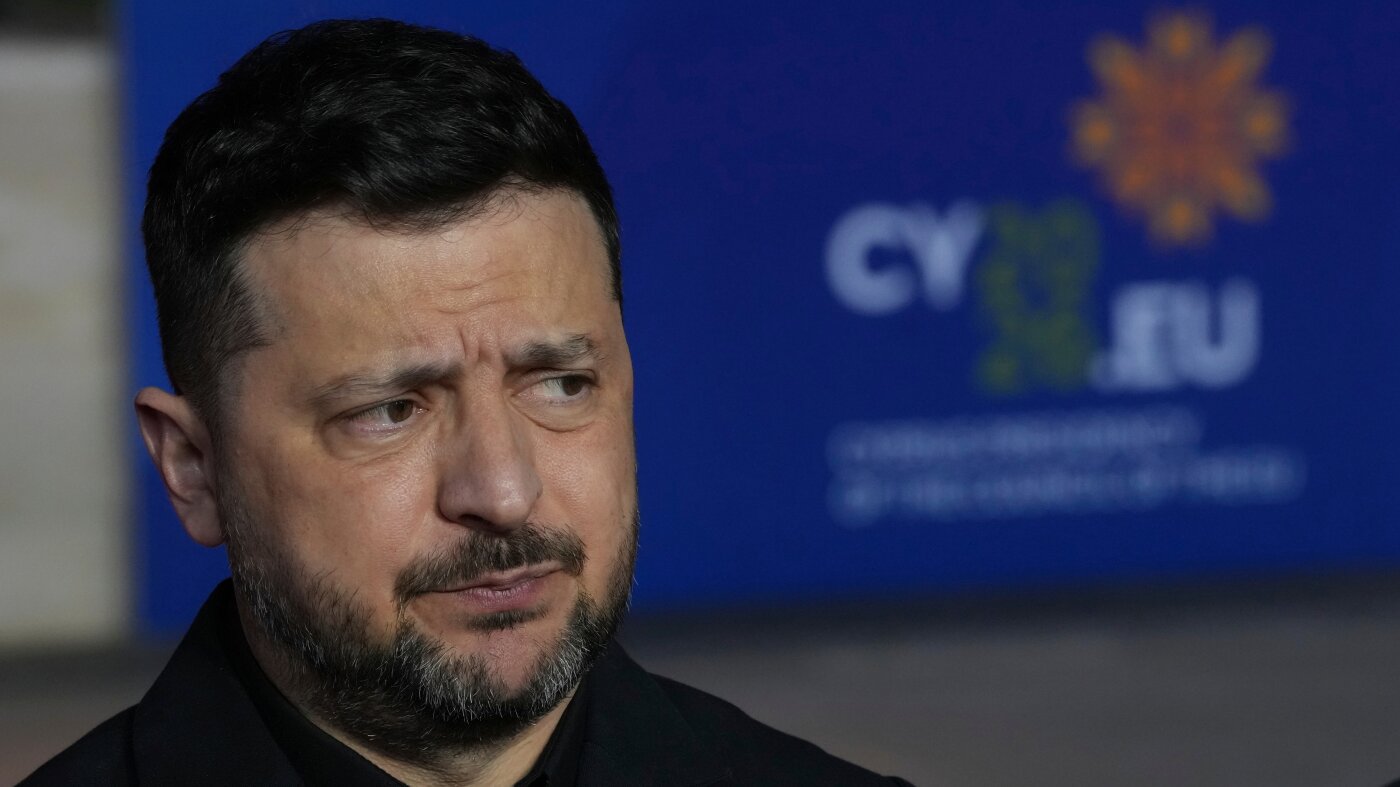

Ukrainian President Volodymyr Zelenskyy delivers remarks upon arrival at the EU Summit in Ayia Napa, Cyprus, Thursday, April 23, 2026.
Petros Karadjias/AP
hide title
toggle title
Petros Karadjias/AP
BRUSSELS – The European Union on Thursday approved a 90 billion euro ($106 billion) loan package to help Ukraine meet its economic and military needs for two years after oil began flowing through a key pipeline to Hungary and Slovakia, ending months of political stalemate.
The EU also approved a new set of sanctions against Russia for its war against Ukraine. The measures were prepared earlier this year and were due to be announced in February to mark the fourth anniversary of the conflict, but Hungary and Slovakia opposed the measure.
Hungary and Slovakia have been locked in a dispute with Ukraine since shipments of Russian oil to the two EU countries were halted in January after a pipeline was damaged. Ukrainian officials blamed the damage on Russian drone strikes. Both countries confirmed on Thursday that deliveries have resumed.
Ukraine desperately needs the loan package to shore up its war-ravaged economy and help keep Russian forces at bay. Hungary angered its EU partners by reneging on a December agreement to provide the funds. The loans are expected to be available in the coming weeks and months.
“Promised, fulfilled, implemented,” the president of the European Council, António Costa, published on social networks. A few hours later, arriving to chair a summit of EU leaders in Cyprus, Costa told reporters that the priority now must be to advance Ukraine’s quest to join the bloc.
Along with him, Ukrainian President Volodymyr Zelenskyy thanked his European partners for their support. “We will work to ensure that the funds are delivered as soon as possible,” he said. “This will strengthen, of course, first of all our army, the Ukrainian forces and will allow us to increase production.”
Pipeline progress
The political green light for the loan package came after Russian oil began flowing again to Hungary and Slovakia via the Druzhba pipeline across Ukraine. Populist Slovak Prime Minister Robert Fico welcomed that development as “good news.”
“Let’s hope that a serious relationship has been established between Ukraine and the European Union,” Fico said.

FILE – A general view of a pumping station at the end of the Druzhba pipeline at East Germany’s PCK refinery in Schwedt, January 10, 2007.
Sven Kaestner/AP
hide title
toggle title
Sven Kaestner/AP
Hungarian energy group MOL said it had “received crude oil at the Fényeslitke and Budkovce pumping stations early Thursday. Deliveries of crude oil via the Druzhba pipeline system have thus resumed to Hungary and Slovakia after a pause of almost three months.”
Ukraine and most of its European backers oppose Russian oil imports that have helped finance Russian President Vladimir Putin’s war against Ukraine, now in its fifth year. But unlike the rest of the European Union, Hungary and Slovakia still depend on Russia for their energy needs.
Hungary’s nationalist Prime Minister Viktor Orbán, who was recently defeated in an election, had accused Ukraine of deliberately delaying reparations, a charge Zelenskyy denied.
Fico said Thursday that he still did not believe the pipeline was damaged at all and alleged that the pipeline and the oil “were used in the current geopolitical battle.”
Another electoral hijacking in the EU
The dispute has raised even more troubling questions about EU decision-making, which can often be hostage to national interests when unanimous votes are required. Several senior officials have called for greater majority voting in recent months.
The 27-nation bloc originally intended to use frozen Russian assets as collateral for the loan. But that option was blocked by Belgium, where most of the frozen assets are located.
In December, the Czech Republic, Hungary and Slovakia agreed not to prevent their EU partners from borrowing money on international markets as long as the three countries did not have to participate in the plan.
But Orbán, who has repeatedly blocked EU aid to Ukraine, angered the other 24 countries by later reneging on that agreement over the pipeline dispute and as the campaign intensified ahead of the April 12 election that he lost in a landslide.
More sanctions on Russia
The EU has also been trying since February to push through a new set of sanctions against Russia to undermine its war effort, but Hungary and Slovakia were also blocking those measures over the oil dispute.
More than 40 ships believed to be part of Russia’s shadow fleet that was illegally transporting oil were attacked.
Oil revenues are the linchpin of the Russian economy, allowing Putin to pour money into the military without worsening inflation for ordinary people and avoiding a currency collapse.
Several banks were attacked and a ban was imposed on Europeans from using Russian cryptocurrencies.
Asset freezes were imposed on about 60 more “entities” – often companies, government agencies, banks or other organizations – adding to a growing list of more than 2,600 Russian officials and entities already under sanctions, including Putin, his political associates, oligarchs and dozens of politicians.