


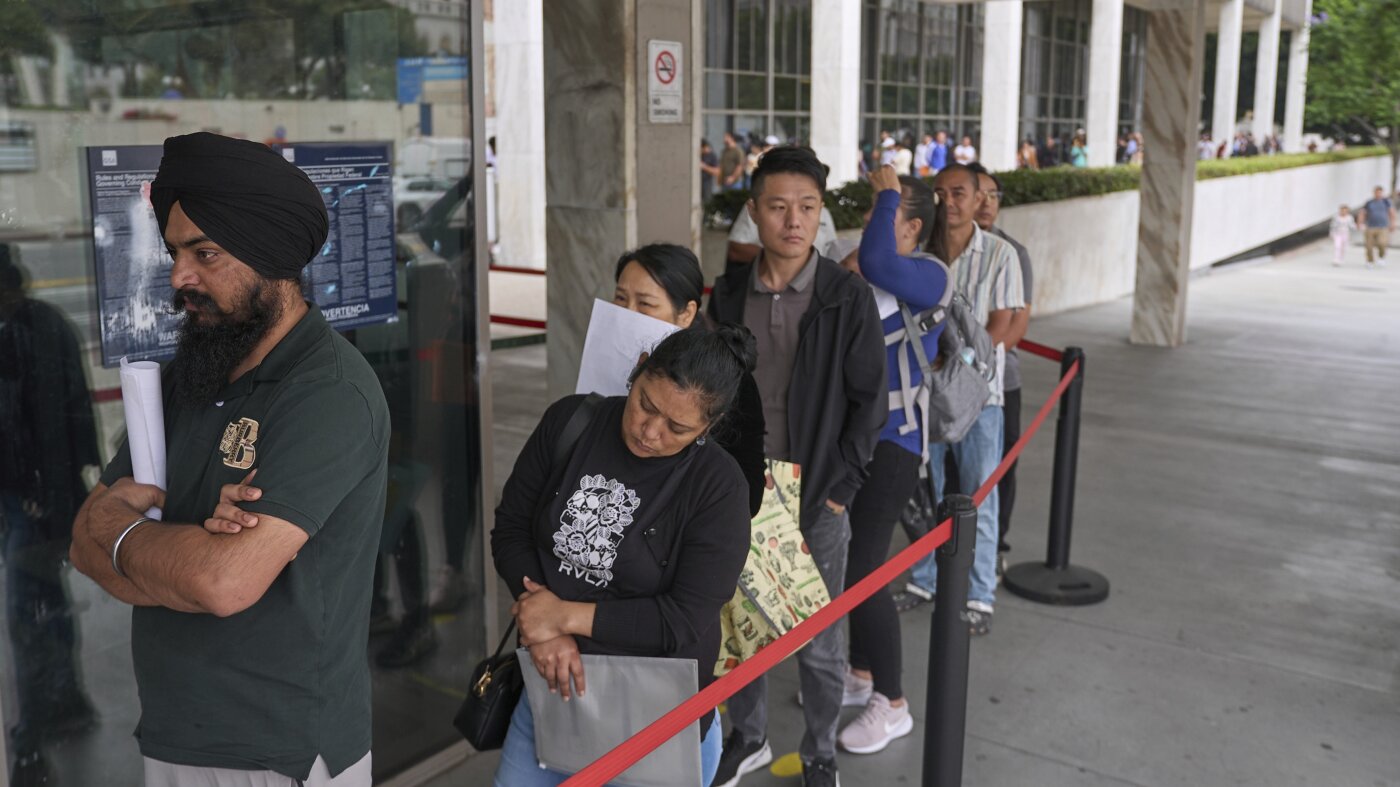

In June 2025, people line up outside the Federal Building in Los Angeles, which houses offices of U.S. Immigration and Customs Enforcement and U.S. Citizenship and Immigration Services.
Damián Dovarganes/AP
hide title
toggle title
Damián Dovarganes/AP
Stay up to date with our Politics newsletter, sent weekly.
Millions of immigrants are stuck in legal limbo, waiting to change their legal status under the second Trump administration, an NPR analysis shows, leaving more of them vulnerable to deportation.
Since early last year, the Department of Homeland Security (DHS) has taken increasingly longer to process applications, meaning a growing number of people are waiting months without confirmation that their application was received, much less reviewed.
An NPR review of data from U.S. Citizenship and Immigration Services (USCIS), the DHS agency that processes and approves immigration applications, shows that nearly 12 million requests for immigration services, such as applying for citizenship, a work permit or other permission to live in the United States, are awaiting a decision.
The growing number of pending applications, which saw an increase in the first three months of the second Trump administration, illustrates one lever of the Trump administration’s overall strategy to curb legal migration. Immigrants are even struggling to get the government to acknowledge that it received their applications, leaving people at greater risk of being deported.
“That’s a really incredible representation of what this administration is trying to do on immigration. It’s ‘strangle everything, focus entirely on deportations and arrests as a measure of success,'” said David Bier, director of immigration studies at the libertarian Cato Institute. “If those are your only measures of success, then who cares about opening applications that might prevent someone from being arrested and someone from having to self-deport?”
The 11.6 million applications pending in the “backlog” include forms to become a citizen, acquire a green card, work or apply for asylum. There are also 247,974 applications in what USCIS calls the “frontlog,” which is tracked separately. These are applications, probably mailed, that were submitted but not physically opened or assigned a category by the agency.
The slowdown comes as USCIS has taken a tougher approach to policing immigration laws over the past year. The administration says slower reviews or stopping some apps entirely are necessary for national security reasons.

USCIS spokesman Matthew Tragesser said this administration has implemented “screening and verification processes” that the previous administration overlooked.
“For years, the Biden administration prioritized naturalization applications approved with minimal vetting,” Tragesser said in a statement to NPR. He listed the various policy changes, such as stricter naturalization tests, social network screenings, and visits to applicants’ neighborhoods, which are intended to “ensure that applicants demonstrate good moral character and adherence to the Constitution. USCIS will not take shortcuts in the adjudication process.”
Changes in immigration processing have created stress and confusion for those hoping to live or work legally in the United States. They are also accompanied by other policy changes that make legal immigration more difficult.
“It’s a very tense conversation between clients trying to prepare for impact,” said Luis Cortés Romero, an immigration attorney in Seattle.

Cortés Romero said one of his clients was denied an interview for his green card in January due to a delay in the process, after waiting a year, and it has not yet been rescheduled. A case like this is among those in the “pending” category. But other cases, which are in the initial phase, have not even started.
“Our clients face immediate anxiety. The conversations we have with clients are like, ‘Did you really send them?'” Cortés Romero said, adding that the agency does not confirm it received these requests until they are opened.
Pending Requests See Early Jump
Pending applications include all cases submitted in a given category, from any period, that have not been approved or rejected. This number has grown steadily over the past decade, more than doubling during that time, according to an NPR review of data from October 2016.
But the backlog increased by 2 million in the first year of the second Trump administration, more than the increase in the four years of President Trump’s first term.
The impact is not uniform. Immigration lawyers said some cases move very quickly and are approved within months. For others, it takes months before the agency acknowledges that it received an application, leaving them vulnerable to deportation if their status is not approved or denied in time.

“We are starting to see data manifest that this administration is slowing or even denying the opportunity for these people to adapt,” said Nicole Melaku, executive director of the National Association for New Americans, referring to people gaining new legal status.
In the second half of last year, the Trump administration also paused many application reviews, including those of all asylum claims, which only restarted in late March. And it halted reviews of all immigration applications for those coming from 39 countries on a travel ban list, citing increased security risks to people from those countries.
Elizabeth Jacobs, director of regulatory affairs and policy at the Center for Immigration Studies, which supports restricting immigration, said the sharp increase in the backlog at the start of Trump’s second term could be because the administration cut other programs that provided legal status but did not depend on USCIS, such as humanitarian parole applications. Still, he said there are concerns about high delays, both for the government and for immigrants.
“Processing immigration benefits efficiently is in the interest of both immigrants and this administration with its law enforcement priorities, because the longer someone has a pending application, not only are they denied those benefits but they could be engaging in unlawful presence,” Jacobs said.

Advocates of the administration’s policies, such as Brandy Pérez Carbaugh, a former research associate at the Heritage Foundation’s Center on Immigration and Border Security, said the delay highlights the need for greater scrutiny in reviewing applications.
“The 11 million pending immigration benefit applications show that our immigration system is not manageable. We need to pause receiving more applications until the backlogs decrease to a manageable level, each year,” Perez Carbaugh said, adding that the agency should focus on addressing immigration application fraud. “The US immigration system is for Americans, not for the rest of the world.”
Frontlog rises sharply, leaving more in limbo
Even if an application is submitted, USCIS may not confirm receipt until it is open. Lawyers said most applications to USCIS are still submitted by mail. This includes visas for victims of human trafficking and domestic violence and minors, as well as various work permits.

Cortes Romero, the Seattle immigration attorney, said the agency moved to some electronic filings during the COVID-19 pandemic, but is still behind on improvements such as creating electronic filing options that could at least speed up the acknowledgment of receipt.
“It really exposed how antiquated the infrastructure…of USCIS is,” Cortés Romero said. “While they’ve made some progress toward being able to do that, they’re still a long way from being able to file things electronically, which is causing a lot of chaos.”
Renata Castro, an immigration attorney with clients nationwide, said immigrants may have to wait up to eight months before USCIS confirms it received their application.
“This is a significant challenge because we have clients who are being placed in deportation proceedings,” Castro said, referring to the initiation of deportation in immigration court. He said sometimes an immigration judge may not issue a final order of deportation if an immigrant can show a receipt and documentation to show they have a pending application with USCIS.
“Have [immigration] judges pressuring us, private immigration attorneys, to produce a document that the government cannot produce and threatening our clients with deportation because the government cannot issue a receipt,” Castro said.
Felicia Escobar Carrillo, former USCIS chief of staff during the Biden administration, said USCIS began publicly tracking the number of applications filed, but not categorized, in 2023.
“There was a problem at the beginning of the Biden administration that we inherited and that cost us a lot to reduce,” Escobar Carrillo said. “It’s gone up and down over time, and that’s a reflection of the requests that come in.”

Quarterly data shows the number of requests in the frontlog was zero in 2023, before jumping to 77,291 at the end of March 2024. Escobar Carrillo said that’s because a surge of people wanted to get ahead of new future rates. But over the next three quarters, that number returned to zero.
That changed once Trump returned to power. During the administration’s first three months, the number jumped to 34,028. As of the end of September 2025, USCIS reported 247,974 cases in the initial registration.
“This has impacted my practice, my mental health, my clients, my clients’ mental health,” Castro said. “They are just overwhelmed, tired and exhausted by the uncertainty.”