


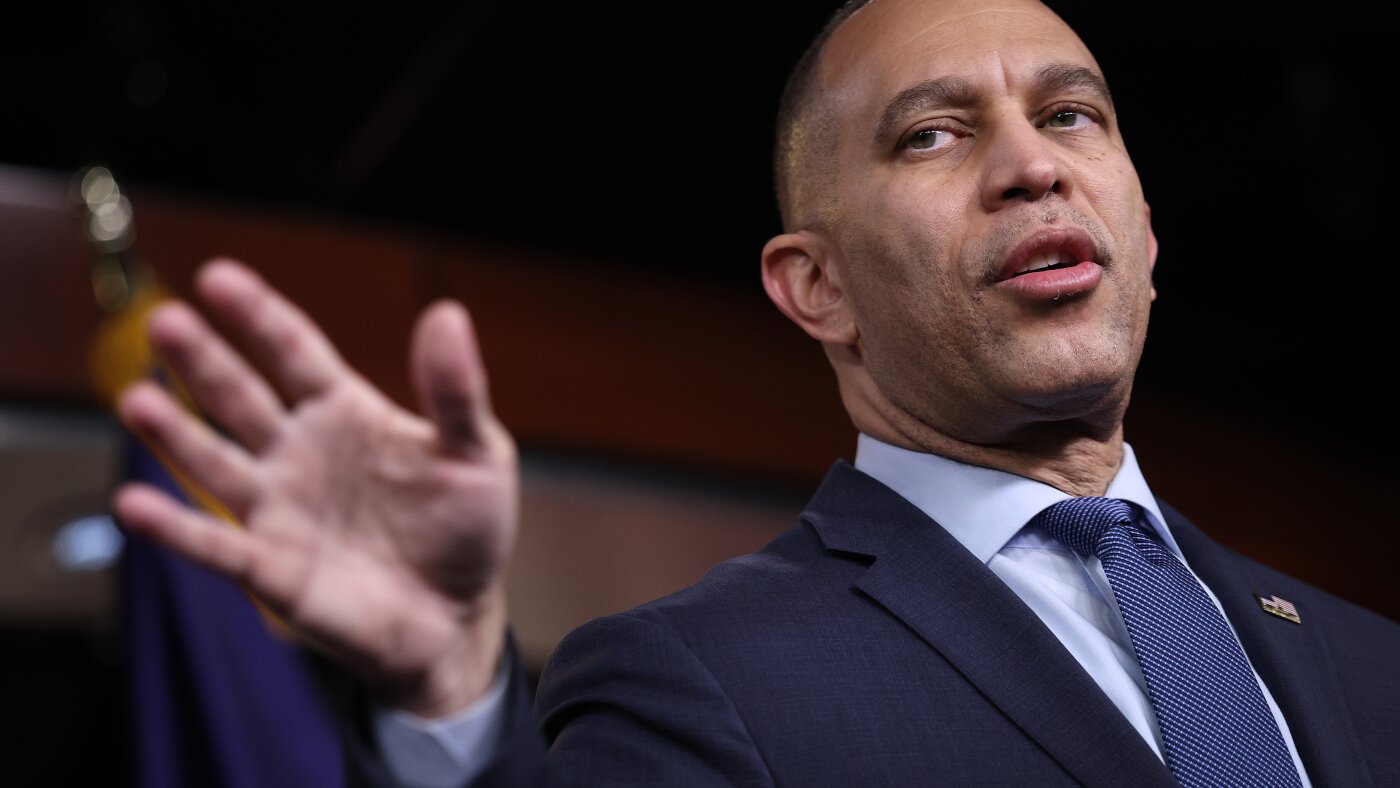
NPR’s Emily Kwong speaks with House Minority Leader Hakeem Jeffries (D-NY), who is still calling for a vote on a war powers resolution following a wave of US-Israeli-led airstrikes against Iran.
EMILY KWONG, HOST:
So what’s next for Iran? The Trump administration’s stated goal is regime change, and some members of Congress still want any next steps to come with their authorization, which was not obtained before this morning’s attacks. House Democratic Leader Hakeem Jeffries of New York is among those still pushing to vote on a power: war powers resolution in the coming days. He joins us now. Leader Jeffries, welcome back to ALL THINGS CONSIDERED.
HAKEEM JEFFRIES: Thanks for having me.
KWONG: First, what is your reaction to the reports of Ayatollah Khamenei’s death? And what does it mean for security in the region?
JEFFRIES: Well, I’m not going to shed any tears regarding his death. He has brutalized his own people and built an Iran that is the world’s largest state sponsor of terrorism. But what comes next is unclear because the Trump administration has failed to articulate a plan, one, to ensure that American forces do not become entangled in an eternal war in the Middle East, which we know would be a disaster. And this notion of regime change has never been successful, as indicated most recently by its failures in Iraq, its failure in Libya, and its failure in Afghanistan.
KWONG: What effect would a war powers resolution have if it passed? You’ve been talking about this for a while now. Just help us understand how the situation on the ground might change right now.
JEFFRIES: Well, the resolution would require Donald Trump to immediately end the use of any American armed forces in any hostility against Iran or any part of its government or military, unless explicitly authorized by a declaration of war coming from the United States Congress.
This, of course, is consistent with what the Constitution requires. And the Constitution requires it because the president, in matters of war and peace, is supposed to present to the American people arguments that we believe he has failed to do at this time to justify or risk another entanglement in a failed foreign war forever.
The resolution would therefore require the immediate termination of any further military action unless the president makes his case to the American people.
KWONG: How are you going to convince enough colleagues in Congress to vote for this, including those who might support some kind of military action in Iran?
JEFFRIES: Well, it’s a bipartisan resolution introduced by Congressman Khanna and Congressman Massie. We think we’ll get some additional Republican support, but we’re working on it right now. We will have a meeting tomorrow Sunday to discuss it. We know there will be strong support within the House Democratic caucus and strong opposition to what Donald Trump has done in this particular case or in the future. But we have a few days to try to reach the 218 votes necessary to guarantee that the resolution is approved.
KWONG: All of this is happening in the midst of weeks of negotiations with Iran. So what do you wish the Trump administration had done instead? – because, as you said in a statement earlier this week, Iran should be, quote, “confronted aggressively over human rights, abuses, threats to allies and more.”
JEFFRIES: Yes, that aggressive confrontation, in my opinion, should involve strong diplomacy along with sanctions, as they were very successful under the Obama administration in being able to limit Iran’s nuclear program. This wasn’t an issue until Donald Trump abandoned the Iran nuclear deal and has now brought us to the brink of a possible war in the Middle East. So aggressive diplomacy accompanied by aggressive sanctions is the best course of action. And unfortunately, we have not seen this in this administration, which risks becoming embroiled in another failed foreign war forever.
KWONG: So for you, the only solution, the only way forward is to reduce the tension. However, would it be responsible to withdraw after the US and Israel started this?
JEFFRIES: Well, that will be a question the administration will have to answer. They have put us in this situation. But what we do know is that greater military action: you can’t undertake successful regime change or change conditions on the ground simply with the military’s air superiority, right? We… that was clear in Afghanistan and it was also clear in Iraq. This will also be the case in Iran. Therefore, withdrawal, at this time, at least from future military actions, without obtaining explicit authorization from the United States Congress, under the Constitution, is the next course of action that must be taken.
KWONG: The United States and Israel seem to be working in unison here, and it is an alliance that is fundamentally based on security, right? So I’m wondering right now: How do you feel about the state of the US-Israel relationship and what it means for our collective security?
JEFFRIES: Well, I think what, you know, has to happen – and obviously, in the region, Israel is an ally, Jordan is an ally and Egypt is an ally – I think that when it comes to the Iranian issue, we have to manage our affairs in terms of compliance with Article 1 of the Constitution and that Congress only has the ability to declare war. When it comes to the broader dynamic in terms of Israel, the most important issue: achieving a just and lasting peace, for example, with the Palestinian people, will require a viable path to a two-state solution.
KWONG: When it comes to Iran, if Trump’s stated goal is truly regime change, how much responsibility does the United States have going forward?
JEFFRIES: Well, the American people believe that our taxpayer money should be spent, right now, to make life more affordable for ordinary Americans in an environment where the cost of living is out of control, where Donald Trump promised to reduce costs from day one. Costs have not gone down. Costs have increased. He is spending taxpayer money in ways that are offensive to the American people, including creating a $75 billion ICE slush fund so they can brutalize and in some cases kill American citizens. And now we are seeing the potential use of taxpayer money to be spent in ways that will lead to a possible endless war. That is not acceptable and that is not what the American people want to see.
KWONG: Last question, Leader Jeffries: What is your plan for this week when you go to Congress? What do you want done?
JEFFRIES: Well, we will meet tomorrow as House Democrats, work to secure the necessary support on our side, and then continue to talk with a handful of our Republican colleagues so that we can successfully pass this resolution sometime on Wednesday or Thursday.
KWONG: House Democratic Leader Hakeem Jeffries of New York, thank you for speaking with us.
JEFFRIES: Thank you.
(SOUND OF MUSIC)
Copyright © 2026 NPR. All rights reserved. Please visit the terms of use and permissions pages of our website at www.npr.org for more information.
The accuracy and availability of NPR transcripts may vary. The transcript text can be revised to correct errors or match updates to the audio. Audio on npr.org may be edited after its original broadcast or publication. The authorized record of NPR programming is the audio record.