


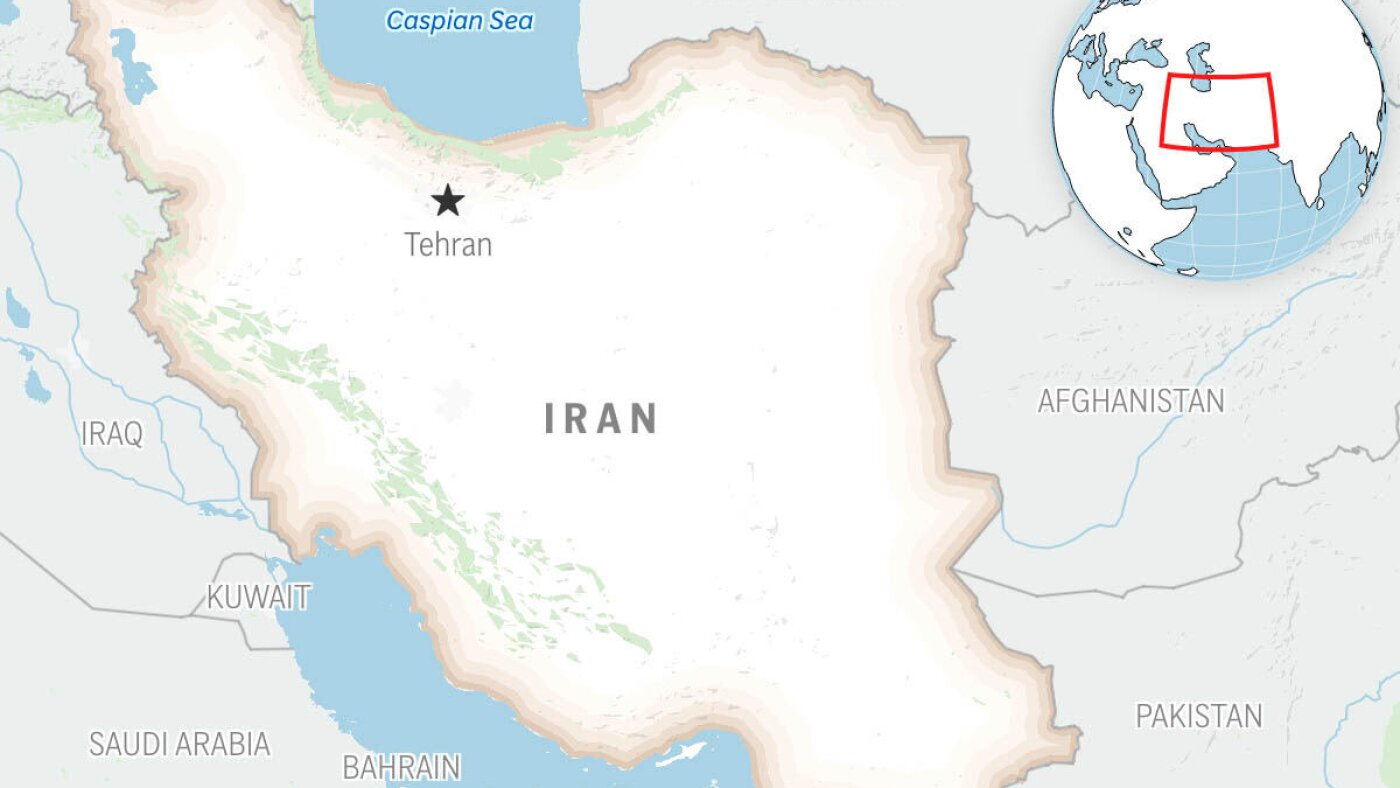

This is a location map of Iran with its capital, Tehran.
AP
hide title
toggle title
AP
DUBAI, United Arab Emirates – Iranian protesters chanted and marched through the streets into Friday morning following a call from the country’s exiled crown prince for demonstrations, even as Iran’s theocracy cut the nation off from the Internet and international phone calls.
Short online videos shared by activists allegedly showed protesters chanting against Iran’s government around bonfires as debris littered the streets of the capital, Tehran, and other areas. Iranian state media broke its silence on Friday about the protests, alleging that “terrorist agents” from the United States and Israel set fires and provoked violence. He also said there were “victims,” without giving further details.
The full extent of the demonstrations could not immediately be determined due to the communications blackout, although they represented another escalation in protests that began over Iran’s weakened economy and have become the most significant challenge to the government in several years. The protests have steadily intensified since they began on December 28.
The protests also represented the first test of whether Crown Prince Reza Pahlavi, whose seriously ill father fled Iran just before the 1979 Islamic Revolution, could convince the Iranian public. Demonstrations have included cries of support for the shah, something that could carry a death sentence in the past but now underscores the anger fueling protests that began over Iran’s weakened economy.
So far, violence around the protests has killed at least 42 people and more than 2,270 have been detained, the US-based Human Rights Activist News Agency said.
Pahlavi, who called for protests on Thursday night, also called for demonstrations on Friday at 8 pm.
“What turned the tide of the protests were former Crown Prince Reza Pahlavi’s calls for Iranians to take to the streets at 8 p.m. on Thursday and Friday,” said Holly Dagres, a senior fellow at the Washington Institute for Near East Policy. “From posts on social media, it was clear that Iranians had complied and were taking seriously the call to protest to overthrow the Islamic Republic.”
“This is exactly why the Internet was shut down: to prevent the world from seeing the protests. Unfortunately, it probably also provided cover for security forces to kill protesters.”
Thursday night protests preceded internet shutdown
As the clock struck 8 p.m. Thursday, Tehran neighborhoods erupted in chants, witnesses said. Chants included “Death to the dictator!” and “Death to the Islamic Republic!” Others praised the shah, shouting: “This is the last battle! Pahlavi will return!” Thousands of people could be seen on the streets before all communication with Iran was cut off.
“Iranians demanded their freedom tonight. In response, the Iranian regime cut all lines of communication,” Pahlavi said. “It has shut down the Internet. It has cut landline telephone lines. It may even try to jam satellite signals.”
He went on to call on European leaders to join US President Donald Trump in pledging to “hold the regime accountable.”
“I call on you to use all available technical, financial and diplomatic resources to reestablish communication with the Iranian people so that their voice and will can be heard and seen,” he added. “Do not let the voices of my brave compatriots be silenced.”
Pahlavi had said he would offer more plans depending on the response to his call. His support for and from Israel has drawn criticism in the past, particularly after the 12-day war Israel waged against Iran in June. Protesters have shouted in support of the shah at some demonstrations, but it is unclear whether that is support for Pahlavi himself or a desire to return to a time before the 1979 Islamic Revolution.
The internet shutdown also appears to have taken Iran’s state and semi-official news agencies offline. The recognition by state television at 8 a.m. on Friday represented the first official news about the demonstrations.
State television claimed that there was violence in the protests that caused casualties, but did not provide further details. He also said that “private cars, motorcycles, public places such as the subway, fire trucks and buses” were set on fire during the protests.
Trump renews threat over deaths of protesters
Iran has faced rounds of nationwide protests in recent years. As sanctions tightened and Iran struggled after the 12-day war, its rial currency collapsed in December, reaching 1.4 million to the dollar. Protests began soon after, with demonstrators chanting against Iran’s theocracy.
It remains unclear why Iranian officials have not yet cracked down more forcefully on protesters. Trump warned last week that if Tehran “violently kills peaceful protesters,” the United States will “come to the rescue.”
In an interview with talk show host Hugh Hewitt broadcast Thursday, Trump reiterated his promise.
Iran “has been told very strongly, even more forcefully than I’m talking to you now, that if you do that, you’re going to have to pay hell,” Trump said.
Trump demurred when asked if he would meet with Pahlavi.
“I’m not sure it’s appropriate right now to do that as president,” Trump said. “I think we should let everyone out and see who emerges.”
In an interview with Sean Hannity that aired Thursday night on Fox News, Trump went so far as to suggest that Supreme Leader Ayatollah Ali Khamenei, 86, might be thinking about leaving Iran.
“He’s looking to go somewhere,” Trump said. “It’s getting really bad.”