


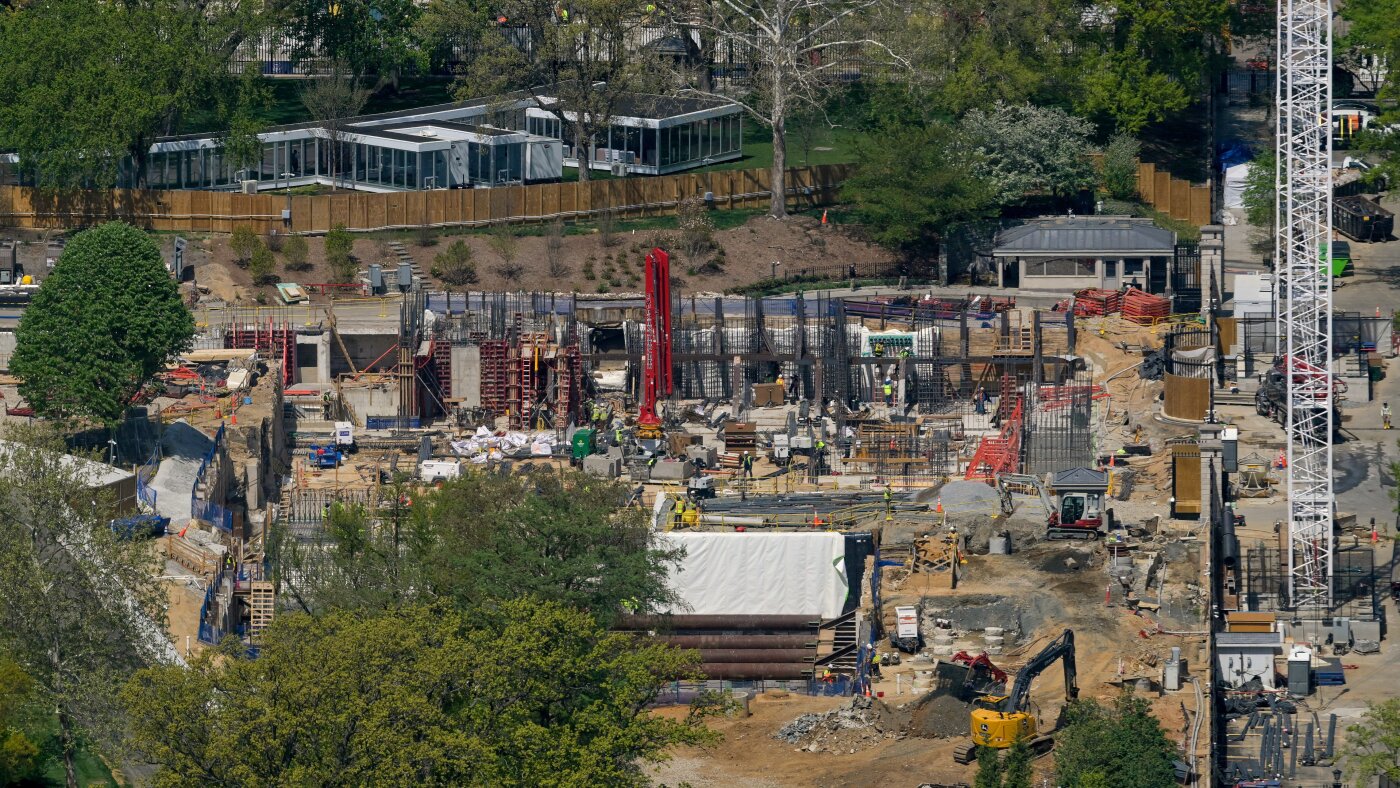

Construction work continues on the White House ballroom, Thursday, April 9, 2026, in Washington, where the East Wing once stood.
Rod Lamkey/AP
hide title
toggle title
Rod Lamkey/AP
Construction of a proposed White House ballroom can continue until April 17, the U.S. Court of Appeals for the District of Columbia Circuit ruled Saturday, as the Trump administration challenges a lower court ruling that ordered construction halted because the project lacked congressional approval.

President Trump has been fighting a lawsuit filed by the National Trust for Historic Preservation in December to block the East Wing ballroom plan from moving forward.
A three-judge panel ruled 2-1 that the president’s plan for a massive neoclassical ballroom can temporarily advance while the lower court further reviews the case. Saturday’s decision gives the administration time for the Supreme Court to weigh in on the site’s future.
The appeals court’s decision suspends a March ruling by U.S. District Court Judge Richard Leon, a George W. Bush appointee, who had ordered that construction must stop by April 14, “until Congress authorizes its completion.”
The administration began demolishing the east wing in October to make room for the new ballroom, which is expected to seat 1,000 guests and cost at least $300 million. Trump has defended the ongoing construction, saying the space is needed to host large events. Last month, the president argued that stopping construction of the ballroom would pose national security risks, citing the existence of a secure bunker beneath the ballroom.
Trump told reporters on March 29 of his administration’s plans to upgrade the FDR-era bunker: “The military is building a huge complex under the ballroom.” He added that the ballroom “essentially becomes a shed for what is being built below,” adding that windows of “high-quality bulletproof glass” would protect the facilities below “from drones and… anything else.”
Construction of the ballroom was approved in February by the Fine Arts Commission, a federal agency with construction review authority in D.C., and made up of a majority of Trump appointees.
In response to Saturday’s ruling, Carol Quillen, president and CEO of the National Trust for Historic Preservation, expressed no concern that construction would continue for three more days. In a statement, the nonprofit said it appreciated the court’s quick action and would await further clarification from the district court.
“The National Trust remains committed to honoring the historic significance of the White House, upholding our collective role as stewards, and demonstrating how broad consultation, including with the American people, produces a better overall outcome,” Quillen said in a statement.
Lawyers for the Trump administration did not respond to NPR’s request for comment.
NPR’s Chloe Veltman contributed to this report.