


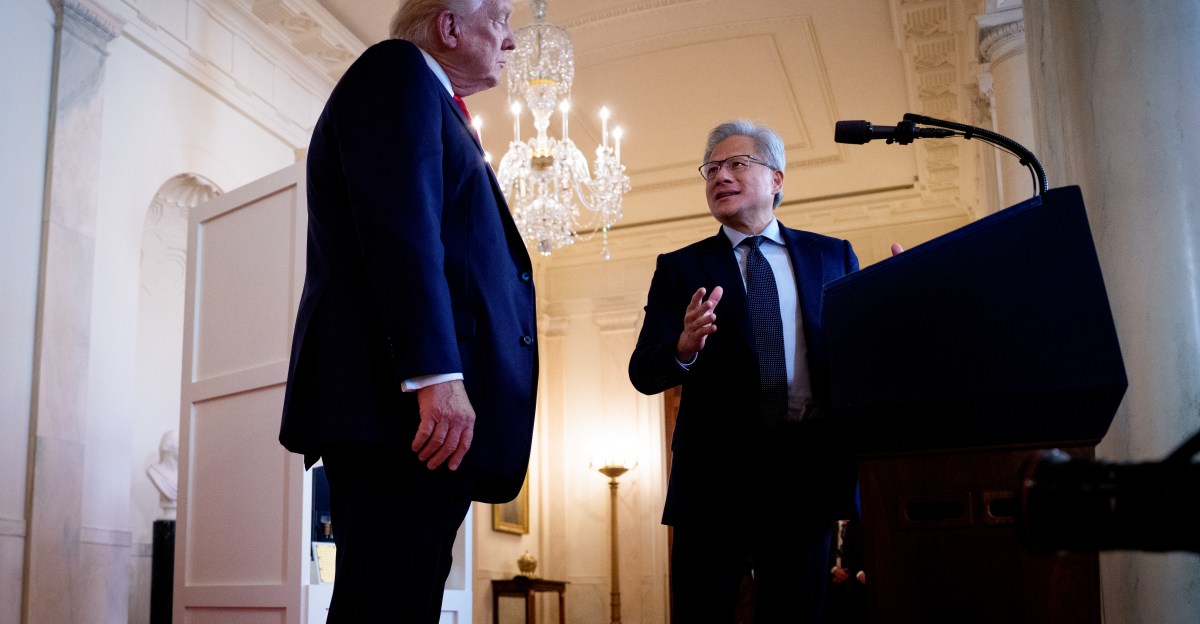
This week, President Donald Trump announced that he would allow US chipmaker Nvidia to sell its advanced H200 chips to China, describing the move as reversing a failed Biden administration policy that he said “slowed down innovation and hurt the American worker.”
He continued: “That era is over.”
The first thing that stands out about the decision is that it is a clear victory for Nvidia and its allies in the administration over Washington’s China hawks, who have pushed to block China’s access to the chips needed to develop the most advanced AI models. (Nvidia’s even more advanced B200 chips are still off the table.)
The second notable thing is that if this is the end of an era, it is an era that began during Trump’s first term. “The original person who moved the United States toward a chip control strategy was Trump,” said Steven Feldstein, a senior fellow at the Carnegie Endowment, who studies technology and geopolitics. This era began in earnest with Trump’s bans on supplying US-sourced components to Chinese tech giants ZTE and Huawei in 2019, citing those companies’ ties to the Chinese government and military.
Feldstein says it was these measures that first caused Chinese leaders to think seriously about how to escape their vulnerabilities to US-controlled choke points in chip supply chains. (While China has its own semiconductor manufacturing, the most advanced chips are overwhelmingly designed by American companies, namely Nvidia, and produced in Taiwan with equipment made in the Netherlands.)
This was an area of continuity between the early Trump and Biden administrations. Biden tightened restrictions on Huawei and also expanded the policy, restricting not only the equipment used by Chinese companies to make chips but also exports of the most advanced chips themselves. This happened against the backdrop of Russia’s war in Ukraine, during which Chinese companies were accused of supplying technological components to Russia in defiance of US sanctions, as well as the AI boom that began in earnest with the launch of ChatGPT in 2022.
In the view of some Biden administration officials, the United States and China were in a new arms race to develop superintelligent AI, and the United States’ control of the chip supply chain gave it an advantage in that race. This culminated in a wide-ranging rule that divided the world’s countries into three tiers of access to American chips. America’s closest allies could buy the chips, adversaries like China and Russia couldn’t, and most of the world was in the middle, facing scrutiny.
However, since Trump’s return there has been active debate over the strategy of restricting chip exports. On one side are China hawks in both parties who largely support these measures; There are bipartisan bills proposed to codify Biden’s restrictions into law. Their argument is that restricting the most advanced AI chips, such as Nvidia’s H200, will preserve the United States’ advantage in the AI race, which is particularly important given China’s efforts to develop AI-related military capabilities. AI developers, notably Anthropic’s Dario Amodei, have also openly supported the restrictions.
The most influential voice on the other side of the debate has been the world’s most valuable company, Nvidia, whose CEO Jensen Huang reiterated that the best way for the United States to maintain AI supremacy is to keep the rest of the world dependent on American chips. (Chinese companies have also been circumventing restrictions by importing black market chips or operating from data centers in third countries.)
Born in Taiwan, Huang had long been scrupulously apolitical, which was easier to achieve in the days when Nvidia was best known for making the graphics cards that made games like Doom and Quake possible. But his company is now deeply tied to the rise of AI and all the geopolitical entanglements that entails, and Huang has lately been an unavoidable presence at Trump’s side, possibly replacing Elon Musk as the tech CEO closest to the White House. It surely doesn’t hurt their cause that the rise of AI is keeping the stock market afloat; Nvidia itself represents about 8 percent of the S&P 500. The prospect of the United States taking a cut of Nvidia’s revenue certainly sweetened the deal.
The chipmaker also has allies in the administration, notably investor, influential podcaster and White House AI czar David Sacks, who has argued that American interests are best served by loosening restrictions to help American companies maintain market share. Commerce Secretary Howard Lutnick has also argued that the United States should try to keep China “addicted” to American chips. It’s been a big week for this tech-aligned Trumpworld faction, between this announcement and Trump’s mockery of an executive order blocking state regulation of AI despite the objections of some of his MAGA allies.
In particular, although Huang and Sacks often frame their arguments in terms of maintaining the United States’ advantage over China, it is not even clear that Trump is very interested in that. His statement made it clear that “President Xi responded very positively!” to the advertisement.
Withdraw from “great power competition”?
In 2017, the Trump administration proclaimed in its National Security Strategy that “great power competition” had returned, a framework that the Biden administration also enthusiastically embraced. The chip restrictions were part of an overall strategy to maintain a technological and military advantage over a rival great power. This Trump administration appears less interested in competing with China than in reaching agreements with it, a reality underscored by a new National Security Strategy for 2025, released last week, that prioritized security concerns in the Western Hemisphere and culture war conflicts with Europe over great power competition.
Trump’s decision puts Republican anti-China hawks in an awkward position. “The CCP [Chinese Communist Party] will use these highly advanced chips to strengthen its military capabilities and totalitarian surveillance,” said Rep. John Moolenaar, co-chair of the Select Committee on Competition with China. And it’s another example of the degree to which personal relationships and business interests often guide this administration’s foreign policy more than ideology or traditional national security concerns.
However, it’s also possible that Nvidia has won over the wrong government. Despite Trump’s announcement, China plans to limit domestic access to H200 chips, as part of a strategy to encourage its own companies to make products that compete with American ones.
Trump may have declared a hack in the chip war, but no one told Beijing.