


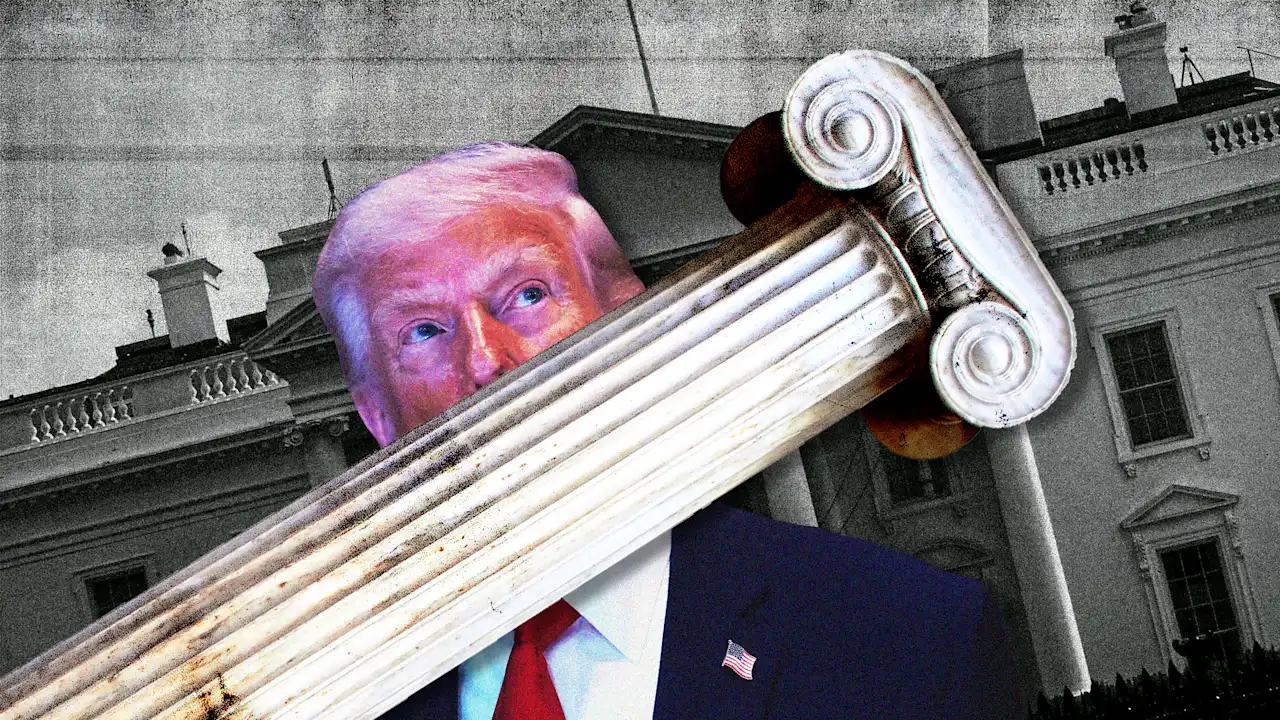
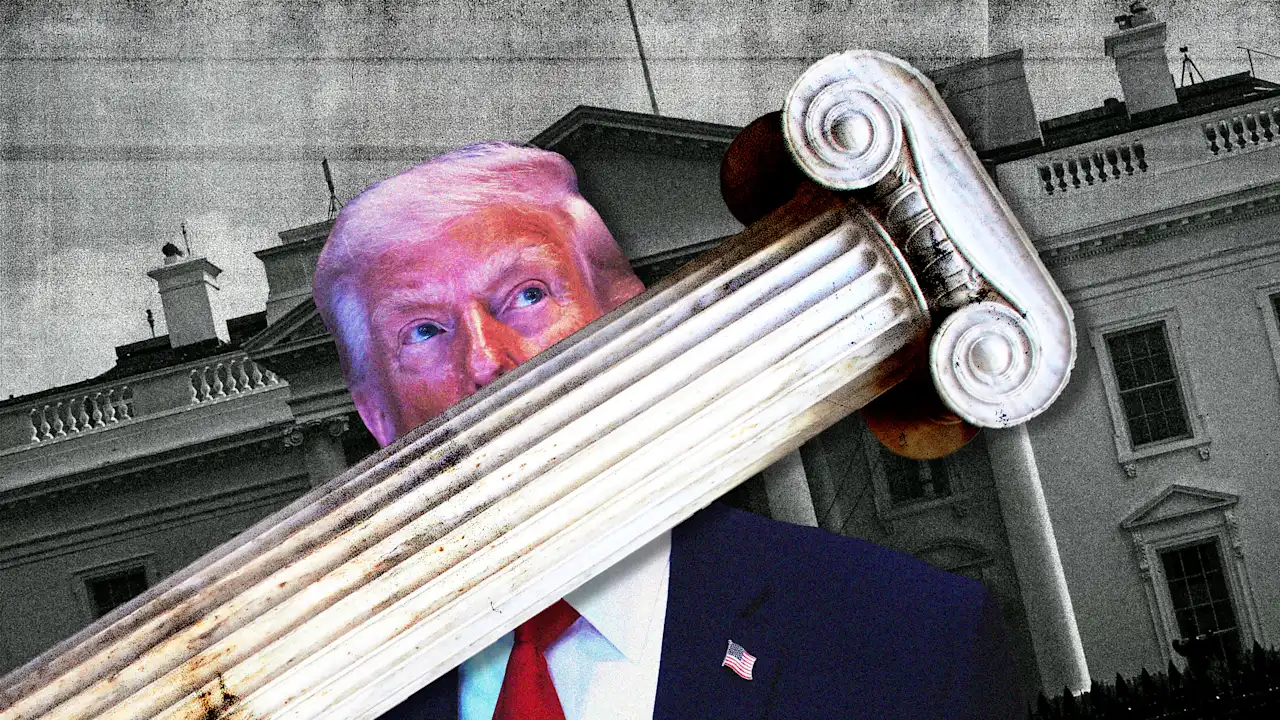
Sand was thrown into the wheels of President Donald Trump’s White House Grand Ballroom plans on March 31, 2026, when U.S. District Court Judge Richard Leon ordered a pause in construction.
The president, the judge wrote, was the “manager” of the residence, not its “owner.” In response, the Department of Justice filed an emergency motion, asking that construction be allowed to resume due to safety risks caused by the project being in a state of limbo.
American presidents, unlike other world leaders, have not sought to translate their own architectural tastes into national monuments.
In this sense, Trump is the exception. His approach to remaking the federal architecture has mirrored his approach to university funding and immigration enforcement: move fast and break things.
But Trump’s imposition of his aesthetic preferences not only threatens to erase chapters in the history of the nation’s federal architecture. It also risks undoing the legacy of presidential wives, influential designers, and the egalitarian ideals that many of these buildings embody.
Striking grandeur
Since beginning his second term in January 2025, Trump has paved over the historic White House Rose Garden, established by first lady Ellen Wilson in 1913 and redesigned by renowned horticulturist Bunny Mellon in 1962, complaining that women’s high-heeled shoes sank into the ground. The art deco bathroom next to the Lincoln bedroom now reflects Trump’s penchant for polished marble. And gold-colored decorative elements have been placed in the simple woodwork throughout the White House, with some of the ornamentation brought from Mar-a-Lago, Trump’s estate in Florida.
Notably, the east wing, which housed the offices of the first lady and her staff, was torn down in the fall of 2025 to make way for a grand ballroom projected to cost about $400 million. The building, if completed as planned, will dwarf the historic White House.
The ballroom also reflects Trump’s taste for grandeur and opulence, the same aesthetic reflected in the 250-foot “Independence Arch” Trump proposed for the National Mall.
Trump has repeatedly complained that public buildings in Washington, D.C., lack grandeur. He was briefly cited by Golf magazine in 2017 for describing the White House as a “veritable garbage dump,” although he later denied it.
However, many of the structures he has demolished or attempted to overhaul embody, in their form and decoration, certain republican ideals, such as government by the people, civic virtue, and opposition to concentrated power.
Buildings that embody egalitarianism
Trump has added accents to the White House to mimic the imposing homes of British and European monarchs. But the residency’s original “republican simplicity,” a concept attributed to Thomas Jefferson, actually had a purpose: It signaled the founders’ egalitarian outlook.
In 1792, when Jefferson was George Washington’s secretary of state, he anonymously entered the competition to design a new presidential home. His proposal, which ultimately did not win, was inspired by Renaissance architecture such as Andrea Palladio’s Villa Rotonda. Completed around 1570 in northern Italy, the Villa Rotonda features symmetrical facades and harmonious proportions that have been equated with Renaissance humanism and rationalism.
Elsewhere, Jefferson advocated modeling the young nation’s governmental architecture after the classical tradition, because of its associations with ancient Greek and Roman democracy. This often meant using classical design principles such as restraint, order and geometric harmony, and adapting them by simplifying elements or using locally available materials instead of the expensive marble and other stones favored by the ancients.
A repudiation of “republican simplicity”
In August 2025, Trump signed an executive order, Making Federal Architecture Beautiful Again, mandating that this same classic style inform the design of all future federal buildings.
However, Trump’s own vision for the design of the White House does not align with this directive. On the one hand, the sheer enormity of the proposed ballroom transgresses a fundamental belief in classical restraint.
The columns that will support the ballroom’s south colonnade have Corinthian capitals, the most ornate type of decorative cap for a column. On the contrary, the more sober Ionic capitals currently adorn the columns at the entrance to the White House. One of Trump’s appointees, however, wants to change them for Corinthian capitals.
And the temple-style portico on the east façade of the planned ballroom is awkwardly offset toward the north end, rather than centered as classical tradition would dictate.
Overlooking history
This is not to say that classical principles have never clashed with contemporary design trends.
In 1888, architect Alfred B. Mullett completed the State, War and Navy Building, now known as the Eisenhower Executive Office Building. Mullet was inspired by Boston’s Old City Hall, which was completed in 1865, and in turn was inspired by the governmental architecture of the French Second Empire.
Trump has said he finds the Eisenhower Building’s gray granite façade depressing and would like to paint it white. However, the material itself is a crucial element that binds the structure to the “Boston Granite style.”
If the office building is painted white, in a process that would degrade the granite, a visual key to understanding its architectural and political history would be lost.
Architectural historian Henry-Russell Hitchcock argued how advanced the building was for its time and showed how it mirrored the first skyscrapers built in New York City: Richard Morris Hunt’s Tribune Building and the Western Union Building designed by Hunt’s student George B. Post.
For these reasons, conservationists have sued Trump to try to prevent these alterations.
Bottom-up design, not top-down
I think it’s also important to note that in the original design and construction of many of the buildings Trump disparages, women played huge roles.
As I point out in my book 2025, Women Architects at Work: Making American Modernismwhich I co-authored with Mary Anne Hunting, the contributions of women in architecture and design have often been overlooked.
The Trump administration’s projects in and around Washington will only further obscure the women who shaped federal buildings and the capital’s landscapes.
While the rose garden reflected the efforts of Bunny Mellon and Jacqueline Kennedy, the east wing came under the watchful eye of Edith Roosevelt, the wife of President Theodore Roosevelt. Edith worked hand-in-hand with famed classicist architect Charles Follen McKim on its redesign as the main entrance in 1902. And if it had not been for Jacqueline Kennedy’s public fundraising efforts, the capital may never have had a performing arts venue of national significance, the Kennedy Center for the Arts. In early 2026, the Trump administration announced that the center would close for two years to undergo an estimated $200 million renovation.
While all buildings are living organisms that frequently adapt to changing functional requirements, they are also repositories of national memory.
In 1961, a young Daniel Patrick Moynihan, who, as a U.S. senator from New York, would later advocate for historic preservation, wrote “Guiding Principles for Federal Architecture” on behalf of an ad hoc government committee on office spaces.
“The development of an official style should be avoided,” he wrote. “Design should flow from the architectural profession to Government, not the other way around.”
As Judge León made clear in his ruling, no government official, not even presidents, “owns” the federal architecture. The American people do. And it is up to its representatives in Congress to decide whether to destroy it or renew it, taking into account that it is an inextricable part of the country’s history.
This article was written in collaboration with Mary Anne Hunting, PhD, an independent scholar in New York City.
Kevin D. Murphy is a professor and chair of art history at Vanderbilt University..
This article is republished from The conversation under a Creative Commons license. Read the original article.